All posts by Thomas Greve

Learning the Ways of Kyudo

kyudo masters & guests


kyudo

Hello everyone,

This is Burcu and I’m supposed to tell you about our “kyudo” experience in Omura city. Maybe you are curious about what “kyudo” is, so I’m not making you wait anymore. “Kyudo” is a Japanese sport which you’re trying to shoot a target with an arrow by using a special – and very cool – Japanese bow. You also need to wear these special clothes with the lovely gloves. Actually I fell in love with the gloves. I asked the masters to give me one but they said, “No.” 🙁

The key point of “kyudo” is the moment when you take your perfect (!) position and hold for a while before you release the arrow. Traditionally you have to wait until you feel that you are perfect and ready to release.

So at the end of the day, we were all so relaxed and most of us including me hit the targets! It feels wonderful when you it hits the mark. And Nozomi beat Jake in a match.

Guess what, we also got these beautiful money pouches as presents. They were handmade and so cute! But as the final and most important issue, we had lots of fun as usual. Lots and lots of thanks to our “kyudo” masters who were so nice to us, the Up with Omura members, and our wonderful team.

Burcu Tepik (Turkey)
Emotional Nagasaki Atomic Bomb Survivor Speech

Nagasaki Atomic Bomb survivor


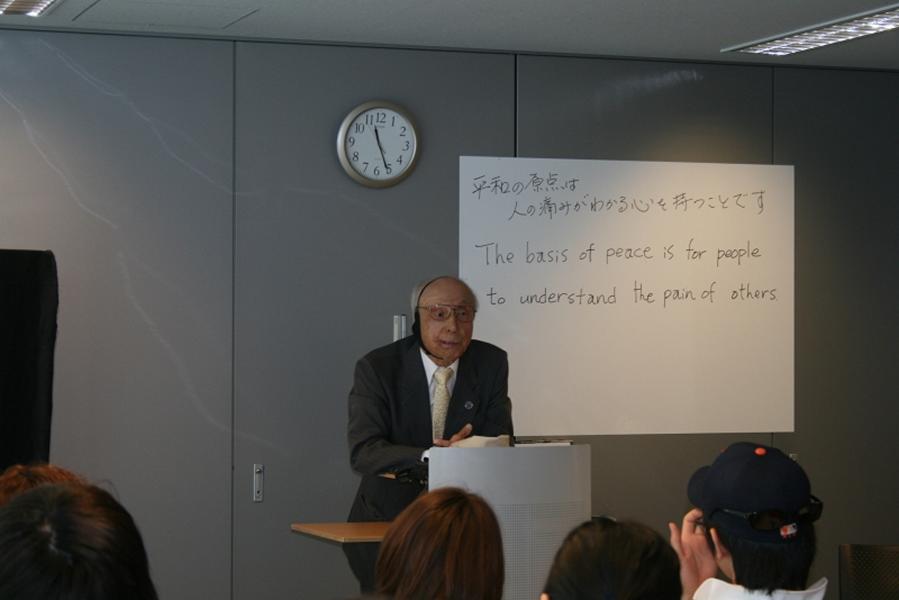
The Nagasaki trip was for all of us very interesting, shocking, and touching at the same time. Our survivor, Mr. Katsuji Yoshida was 13 years old when the atomic bomb exploded 850 meters away on August 9th, 1945.

He was on his way to school when he was thrown through the air and landed in a rice field some 40 meters away. After four months of unconsciousness and hospital treatment, he could go home but there was only his mother left. His father and grandfather died after they went searching for him because of the radioactivity. Only a few victims who were within 1 km are alive today.

Mr. Yosida did not want to live any longer because of his horrific appearance. The right side of his face and arm were totally burnt and his muscles were visible. Because of many operations and a different face color, people stared and laughed at him.

Even today, he still receives treatment regularly at Nagasaki Atomic Bomb Hospital and Nagasaki University Hospital. His goal is now to tell his story and to spread his message: “The basis of peace is for people to understand the pain of others.”

Rachel Anderegg (Switzerland)

Swiss Wooden Spoons

Swiss Wooden Spoons

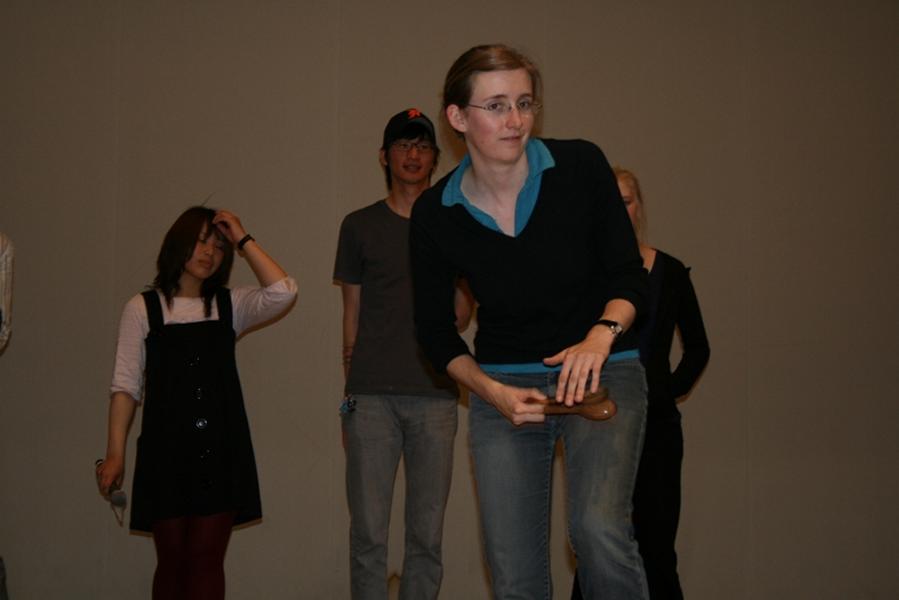
The final program of the World Campus – Japan Spring ’09 started in Omura, Nagasaki. As new participants joined our merry band, they also brought their unique talents with them. One of the more interesting cultural performances involves Rachel of Switzerland playing wooden spoons on her leg! Strange but wonderful music!

Here is a short description of the spoons by Rachel Anderegg:

“Soldiers brought the Spanish kastagnetten to Switzerland. Then the Swiss adapted the idea of this rhythmic instrument by starting to play with their wooden spoons. Those days they use to eat with them. Wooden spoons are used in the heart of Switzerland and it always goes along with traditional Swiss folk music. It is a typical Swiss tradition to play them.

One handicapped person from the Fureai Event wanted to know after my stage performance, if the Swiss eat their meals with hands. I replied that we use forks, knives, and spoons but not wooden ones!”

Farewell to Spring 2009 Program 2 <(‘ . ‘)>

spring 2009 program 2 graduation


heart felt hugs

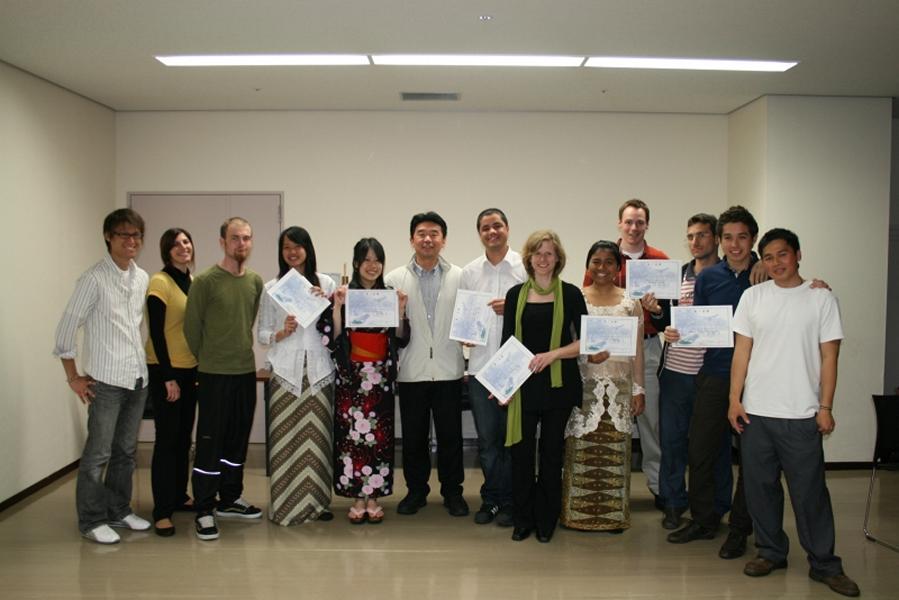
Toyota city was the end of the adventure for some as program two of the Spring ’09 came to an end. It will take some time to readjust back to their “real lives” and to understand their experience with the program. It might take weeks, months, or even years to fully reflect and truly appreciate the unique journey but that day will come.

Saying goodbye is difficult but World Campus – Japan always tries to limit the sadness with warm hugs, nifty thank you cards, and graduation certificates. Thank you all for sharing your whole selves with WCJ and the Japanese community. Your contribution and presence will be missed but never forgotten! <(‘ . ‘)>

Spring 2009 Toyota Company Visit

asking questions at Toyota visit


a Toyota hybrid car

A stay in Toyota city would not be complete without a visit to the mega car manufacturer that the city is named after. After a tour of one of the highly efficient automobile plants, World Campus – Japan members had a rare opportunity learn about the international corporation through a question and answer session at the headquarters of Toyota.

We learned a little bit about the company philosophy of Toyota that makes it one of most successful businesses in the world. Quality checks occur throughout the production process insuring that defects do not spread beyond one machine. This practice of jidoka is really effective as some defects can be hard to detect once the machine is completed. Toyota also uses the “just-in-time” production strategy. This allows the company to limit the production parts to what is require at the moment. In addition to reducing storage cost, this strategy also allows Toyota to quickly implement any changes to the actual part without having to clear out inventory first.

It was very interesting to hear about all the social projects Toyota is involved in. Even though it is not purely altruistic, it is still remarkable to see such a large company practice “corporate social responsibility” on a global level. Toyota gives back to society by heading up or supporting programs in education, environment, and arts and culture in countries that they have a large presence in.