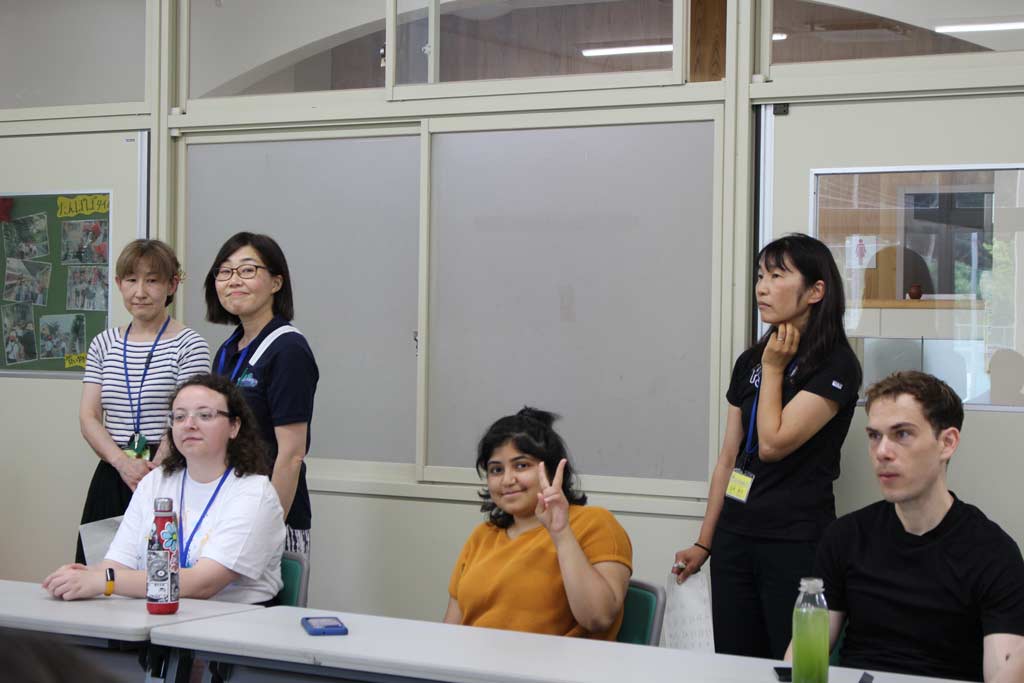
Today was fully focused on learning and making stuff related to Japanese culture. For today we even got an extra person attending, a member from the previous session who enjoyed it so much that she spent her last day in Japan to join us!
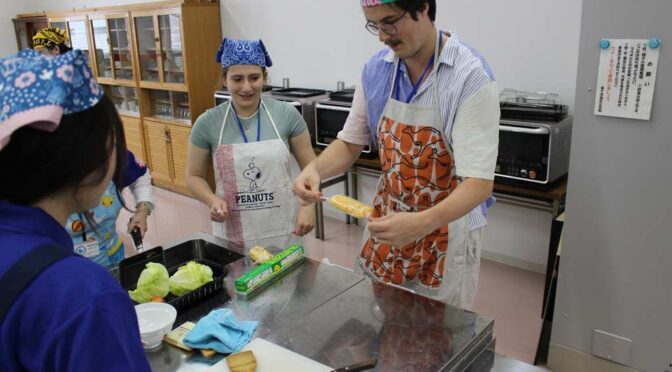
There were quite a few options to pick from, such as Japanese calligraphy and making haiku. You could also sign up for a cooking workshop. I took part in the cooking class and it was great! There were a lot of local people helping out and some students from Kansai University as well. I myself like cooking, but this was a bit different from what I was used to.
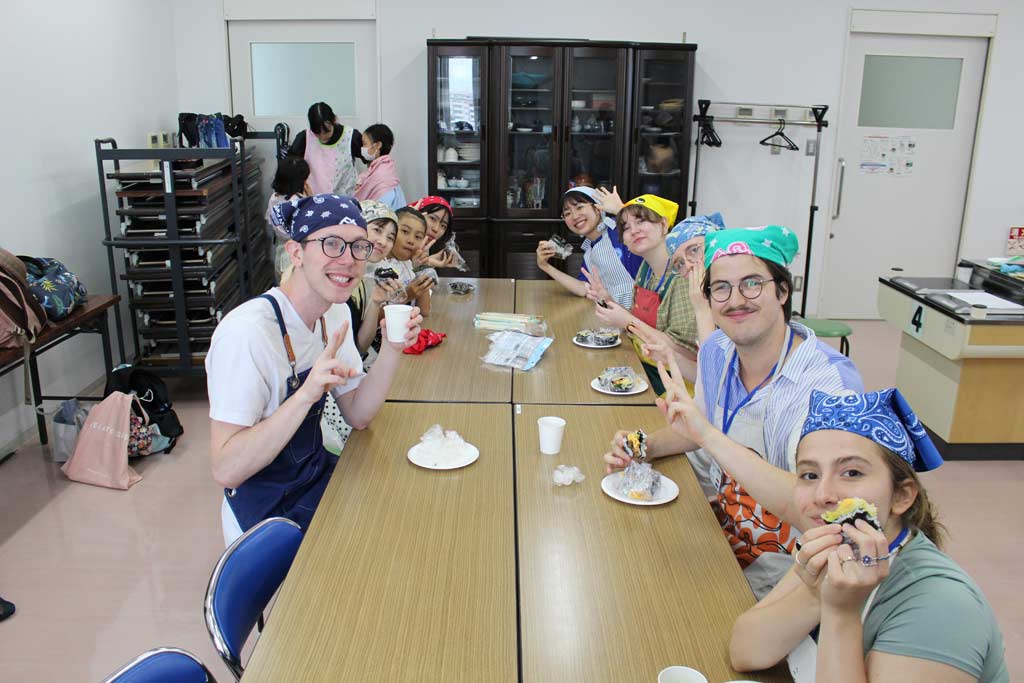
I teamed up with a special member from the previous session to make Onigirazu (onigiri for beginners). We got some help from a very sweet local lady and a Kansai University student. We started with the omelets and we got some help every step of the way. One of the funnier things in world campus is noticing how much hype you will receive for doing tasks the way they want you to do them. I flipped an omelette and got an applause, it was very funny. The food turned out great, after making it we had some time to eat it up (my host family came by, they were thoroughly impressed with our cooking).
Afterwards the cooking squad got some time to do the other workshops. All were held by locals who clearly knew what they were doing. I made a Temari ball and did some calligraphy to finish the workshops off.
We ended the morning with a demonstration of old school Japanese music, which was awesome. I loved every part of it, the amount of energy you can get from doing workshops is something I didn’t think was possible.
The World Campus Japan program is unique as it offers the chance to experience the Japanese culture from an array of perspectives, through several, differing, perhaps unconventional activities. Among them, on June the 16th, we got to play golf with some members of the local community of Isa.
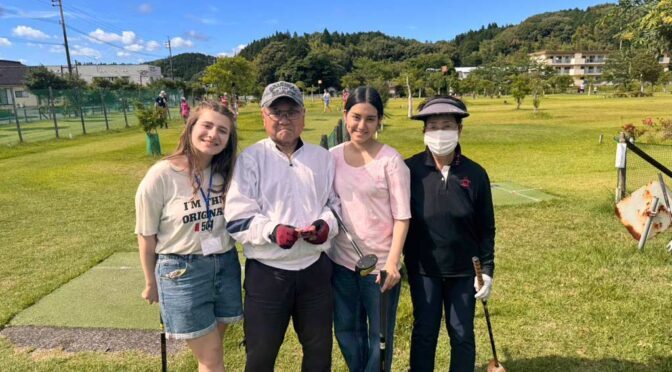
After a morning spent planting rice in the countryside of the city, we headed towards the local Golf Park, where a group of elderly people awaited, ready to meet us with their equipment in hand. We were divided into couples, and each was then assigned to two ‘buddies’ chosen among the community. In my case, I had the honor of meeting Ichiro-san and Tetsuko-san, who started asking questions right away, showing interest in my teammate and I.
I deeply appreciated how hard they tried to explain the game rules in both Japanese and a little English. Eventually, we managed to successfully initiate the game. They were real professionals (Ichiro-san started 8 years ago and Tetsuko-san around 30!), and seeing them play was a deeply humbling experience (I am myself really not a golf champion, and I was at that moment very aware of it).
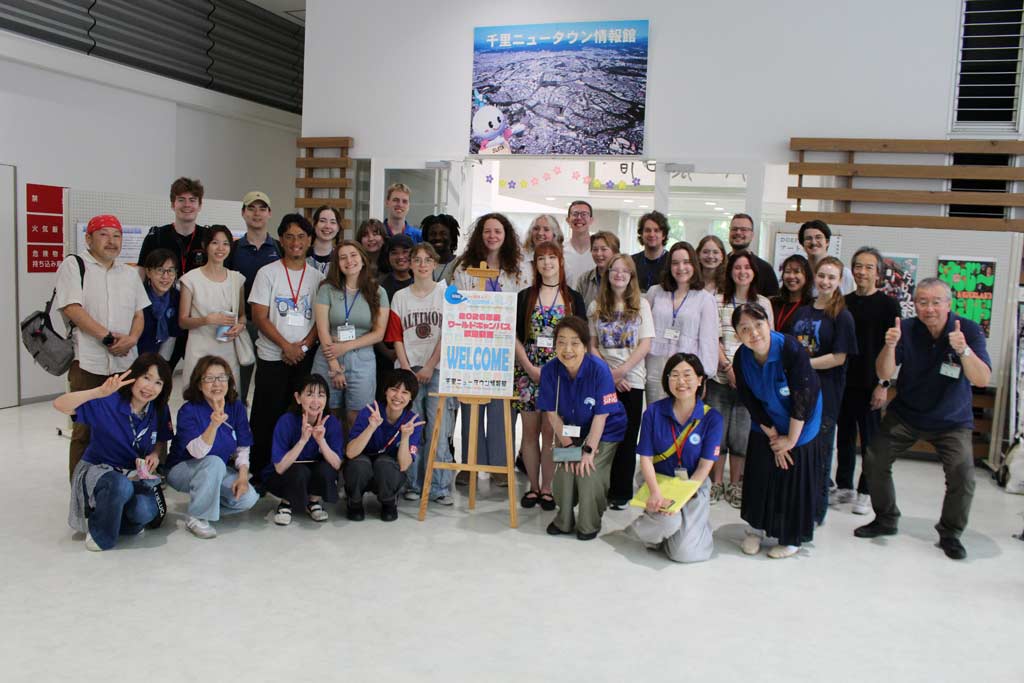
Once we were done, we took the usual group picture and we hugged goodbye. Ichiro-san got me and my teammate some candies to thank us for spending our afternoon playing with them. Before leaving, I had the chance to talk to him for a bit, he asked where I come from, what I am doing in Japan, while I asked him more about his life as a professor in Tokyo. Then, we promised each other that we would meet again someday.
Such experiences make you aware of how much kindness strangers can treat you with and show how no matter the age or the cultural background, people will always find a way to communicate with and understand each other.
The day started off with our host families dropping us off at Kinrin Center. We were visited by Mr. Junichiro Hoshino, the mayor of Abiko City! We were taught about Abiko city’s culture and history, like its famous bird museum, literary masters, Tone River, and its annual fireworks festival! We were even visited by the town’s mascot: Unakichi-San. Much of the history of Abiko City is actually represented in Unakichi-San! He is an old gentleman, referring to the old literary masters in Abiko, and an eel, an allusion to how eel caught in Tone River was considered to be the best, fetching the most handsome price.
Later on, we were able to experience traditional Japanese street performances firsthand, everything including the refined and elegant “kappore” (かっぽれ), to the mesmerizing and grand “Nankin Tamasudare” (南京玉すだれ), an art that is said to have been developed during the Edo Period (1603-1867), rooted in Buddhist tradition. “Nankin Tamasudare” uses loosely woven bamboo sticks to create extraordinary shapes by twisting, folding and extending the sticks to create interesting shapes! After the performance, we were even taught how to use the sticks, finishing with us trying to do the performance too.
Lastly, we learned how to create Mickey Mouse through Balloon Art! I personally struggled with the balloons, as they kept popping haphazardly, scaring me half to death, however, everyone eventually managed to successfully build it, resulting in a satisfying conclusion.
It’s definitely an experience that I, along with the host families and WCI, will remember!
Today might be one of the most exciting and tiring days so far in session 2. It started off with us visiting the most known part of Isehara, Mt. Oyama. I decided to make the smart choice and take the cable car to the shrine we were visiting, Oyama Afuri, rather than taking the 45-minute hike up the mountain in the 30+ degree weather (While we were waiting for the ones who chose to hike, we got ice cream, but we were told to keep that a secret to prevent them from getting jealous, so shhh). At the shrine, we got to experience a Shinto ceremony, and we learnt a lot about Shintoism and the history of the shrines on Mt. Oyama. For lunch we stopped at a ryokan not too far from the Oyama cable car, where we got served tofu prepared in a vast variety of ways. I’m not usually a massive fan of tofu, but the expertise and variety made the dish an experience, and a delicious one at that.
Discussions with the City Hall Officers
After our excursion to Oyama, we went to city hall, where we met with city officials. Together we watched two of our counsellors give presentations on the livability of cities in the Netherlands and Joensuu, a city in Finland. The most interesting part of the visit however, was after the presentations, when we got split into groups and got to properly introduce ourselves to some of the city officials. We were all a bit shy at first, but quickly opened up to each other, before we all shared what our favorite aspect of our own cities were. We participants got to learn about Isehara, and the city officials got ideas on how to improve the livability of a city from all around the world.
At the end of the day, we got to try out replicas of samurai armor. This was the highlight of the day in my opinion. With a katana being part of the outfit, we got some absolutely amazing photos, and some great laughs with friends as we did cool and silly poses. It was a chill and fun way to cap off a great first activity day in a new city.
Anam Preparing for Presentation at Elementary School
Today we visited the elementary school students of Muroo, Nara. The children of this quaint town had so much energy! First, we greeted them with presentations of our home countries. Then, the students introduced us to the festival of Tanabata through a fun trivia game. Afterwards, we divided into groups and helped them put their wishes on a bamboo tree. Some of us had to pick up the students so they could reach the branches. My group was full of eager eyed sixth graders.
The participants followed their respective groups into their classroom to see what their everyday school day was like. The sixth graders I was with were starting their English class; they were a bit shy at first but one by one they began to introduce themselves – granted the first introduction was done through an intense game of “Rock Paper Scissors”. I recall one student practically jumping out of his seat ready to introduce himself as soon as he saw the others doing so. When they were less tense, we began a game of Charades. To practice their English, they wrote the names of the animals in English only. I will never forget one of the counselors acting like a monkey for them and how much they warmed up afterwards. We had lunch together – a meal of rice, miso soup, beans, potatoes with meat, and a carton of milk. I felt like I was back at my first day of school again. After lunch, we headed downstairs for a very invigorating game of dodgeball.
With an intense school day coming to a conclusion, we bid farewell to the students and made our way to Renshoji temple. The temple was originally constructed in 1650 A.D, but was moved to Muroo about 100 years ago. The 19th generation priest led us to first properly greet the Buddha statue by saying a quick prayer and bowing. Then, he led us to a traditional tatami room where we sat on beautiful, red silken cushions. He taught us the proper meditation position before guiding us into Zen Meditation. Personally, I enjoyed this aspect. I could feel the breeze coming from the open slide doors and felt my breath a lot more. The priest came around and lightly hit everyone in the back with a stick six times. He explained three reasons for this: motivation, fixing our posture, or for no reason at all. It was up to us to reflect upon why he did so. Towards the end, however, I began to feel my feet go numb. I was quite relieved when the priest rang the bell twice so I could relax. We discussed the purpose of this special meditation and how it led us to enlightenment over wheat tea and cinnamon snacks. Wrapping up the session, we thanked the priest for allowing us into the temple and I was one of the lucky few who got to ring the large bell outside. Bowing goodbye, we headed to the Shinko Center.
At the Shinko Center, we had our wrap up meeting. I began to feel emotional, as this was the end of Session 1. Our host families hosted a lovely potluck for us as a way for us to spend our last time as a group together. My host mother, who was also head of Muroo’s LOC, explained that the reason we had these potlucks was due to how small Uda is. There are no grocery stores, restaurants, or any large businesses nearby. It was a good way for everyone in the city to bond. I understood this feeling, as I was able to bond with some of the other host families and other participants. The potluck was a wonderful way to end the first session and yet I felt so teary eyed knowing I would have to say goodbye to some amazing people.
Unique Access to Japan!
Enjoy this blog? Please spread the word :)
Manage Cookie Consent
We use cookies to optimize our website and our service.
Functional
Always active
The technical storage or access is strictly necessary for the legitimate purpose of enabling the use of a specific service explicitly requested by the subscriber or user, or for the sole purpose of carrying out the transmission of a communication over an electronic communications network.
Preferences
The technical storage or access is necessary for the legitimate purpose of storing preferences that are not requested by the subscriber or user.
Statistics
The technical storage or access that is used exclusively for statistical purposes.The technical storage or access that is used exclusively for anonymous statistical purposes. Without a subpoena, voluntary compliance on the part of your Internet Service Provider, or additional records from a third party, information stored or retrieved for this purpose alone cannot usually be used to identify you.
Marketing
The technical storage or access is required to create user profiles to send advertising, or to track the user on a website or across several websites for similar marketing purposes.