Thinking about My Time in Japan This Past Summer

Amanda


WCI bridges people from around the globe to become part of the world community. Various activities were offered as part of the program curriculum. From living with host families, getting to know Japanese cultures to communicating with various people from other parts of the world. With that, people’s views change!

Over all, this program is not a normal program because a sense of becoming a family happened for most of us. It started from our first meeting at the Narita airport, where almost all members came from all over the world. When we introduced ourselves to each other, we all made an effort to not let language and other differences become an obstacle. In the first several days of the program, we stayed together in an accommodation, where we got to know each other before eventually meeting local Japanese community members.

During our first city in Ueda, it initially felt strange to live with families as foreigners. But in the long run we felt very lucky to be able to experience the direct interaction and welcoming spirit by the locals. During the theme activities of Food and Society, we were taught about how Japan processes the land and their resources to produce food. Other memorable activities included the Firefly Festival, interacting with pupils from a junior high school, where we played, joked and studied together and also the courtesy call to the mayor’s office. And definitely, the “Arigato Evento” could not be forgotten.

The second city, Tama, was the last city for the first session. Tama was the “Hello Kitty city”, with the presence of the Sanrio Puroland amusement park. There were plenty of contrasts between Ueda and Tama. Tama is part of the greater Tokyo metropolitan with various modern and sophisticated facilities. This city theme was Population and Society. We were taught about the development of this city in the past 60 years. Metropolitan tours were very impressive because we got to know so much about the younger generation and how it contrasts with the older generations with differences but also with respect. Host family day was also very special for us, where we experienced things all day long with our host families. I even got to visit Tokyo Disneyland, the place of my dream! We also met Kyoko Nathalia Takahashi, she was a person of Mexican-Japanese descent and it was truly wonderful to be able to meet her.

Out of all of the participants only, I, Lita and Jackie were to only stay for the first session. We all wanted to join the second session and stay with our newly met friends until the program ended. The idea of leaving was really very sad and touching.

The third city, Toride shi, had a Community Revitalization theme. It was the beginning of the second session, where we met the 4 new members before Lita and I had to leave. Truly a very pleasant matter! My short stay in Toride shi taught me a lot as well about Japanese culture such as kite instruction, Koto (Japanese zither), Shakuchi, Karate, Bon dance, Takoage, and Turushi, as well as the production method of sake!

After returning to Indonesia for a short time, I was quite fortunate to have the opportunity to once again feel the fresh Japanese air, the beauty of city scenery and the height of the skyscraper buildings. Yes, I once again returned to Japan to join my friends in the second session! It was a surprise to the group and I really startled everyone! Possibly I was mad, I did not have common sense, but I dared to come back and was so happy! The fourth city, Mito shi, is the city proud to be the home of the sticky, protein filled Japanese natto and also gave WCI insights about nuclear energy during a power plant visit as well about an international business at the Canon Company. Mito, was also the city that had the nearby beauty of the sea. We experienced the Hanabi festival, the fireworks festival to celebrate the summer season. Truly a beautiful experience!

Hiroshima was the last city in Summer’s 2008 trip to Japan. The city theme was Peace and Conflict. On August 6, 1945, this city had been attacked by an atomic bomb and was destroyed. However, with lots of support and hard work, now Hiroshima is now one of the biggest cities in Japan and is very much alive. And on August 6 each year, many Japanese people along with people from around the world recall the incident by holding a peace ceremony as well as a lantern festival in the spirit of remembrance and peace. Words could not describe the environment where everyone gathered with mutual promises to always maintain peace between individuals, families, ethnic groups and internationally.

The end started our separation and really inauguration ceremony to what is to come because we successfully undertook the WCI Summer 2008 program. There were so many feelings that spilled into one- happiness, sadness, relief, frustrations, love, and many others. WCI was not only a summer season program but became part of our family. The experience we lived was now a beautiful new community that was created by us together. Yes, we felt very sad because of being together for so many days but we had to go back to each of our homes and other realities. However one day we will definitely meet again as an intact family. Yes, we are already planning the reunion party!!!!

(Amanda Soeprobo, Indonesia)
Wrap-up – Super Happy Sunshine Funtime Tour


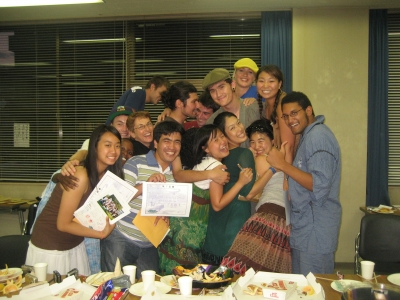
Less than two months. It was a short amount of time but enough for a bunch of strangers from fourteen countries to come together. During that time we learned, we played, we had fun, we got frustrated, we overcame, we laughed, and we cried together. And as a group, we successfully completed the World Campus International summer program. Yay!! Congratulations!! 😉

There were great times where everything was peachy and fun. From hiking Mt. Taro, to the walking tours of Tokyo, to attending the Peace Ceremony in Hiroshima. Everything was not always super happy though. There were also demanding times where we met challenges. From our first “Thank-you Event” rehearsal, to our struggles in “getting over the rope”, to our final goodbyes at the airport. Those were difficult times but we always somehow prevailed as a group.

It is hard to imagine the amazing experiences we would share when everyone first stepped off the bus at the Music Village in Ueda City. Everyone seemed so different and I did not know how the group would mesh together or how long it would take. Living together at the Music Village for the first few days obviously allowed us to connect sooner but I would like to commend everyone for being so open and personable to those that would join later. This program can only succeed if everyone works together, plus it is also a lot more fun when everybody gets along. Thus, it was a pleasant surprise for me to see such harmony in so little time.

Although WCI is not an academic program, it is undeniable to state that we all learned much during the tour. Staying with host families offered us the best opportunity to experience Japanese life and culture. What we have learned was not just relegated to Japanese culture either. Because we were such a diverse group, we were able to learn a little bit about the other countries too. We were all put in an uncomfortable situation in a country foreign to many of us with so many different personalities. Such as life, sometimes the personalities conflicted, yet we all learned about ourselves and how to handle such uneasy situations.

It might be cliché to say, but our little community was much like a family. Every one of us went through tremendous highs and deflating lows but we were always there for each other. Although we are parted now, our shared experiences will never be forgotten. Thank you all for the wonderful memories. It is very difficult not to get overly nostalgic when reflecting back on the tour but it was truly a super happy sunshine funtime.

(Guang Yeung, USA)

The Hiroshima Lantern Festival


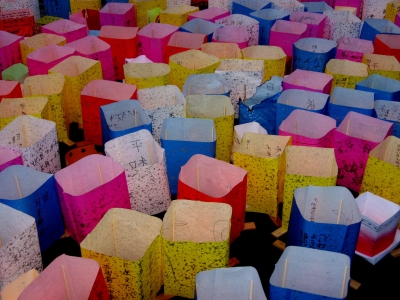
On August 6th, 2008, World Campus — Japan members along with people from all over the world and local community members participated in the Hiroshima Lantern Festival. The ritual was held on the evening of the anniversary of the world’s first atomic bombing. During this festival, blue, green, red, pink, and white cube-shaped lanterns float down the Motoyasugawa River in the twilight. Japanese Buddhists believe that every year the souls of the dead visit their descendants. When the dead return, the lanterns on the river light the path, guiding the spirits of the A-Bomb victims back to heaven.

Despite the large crowds of people, the memory of the solemn event that occurred 63 years ago was still so beautiful and serene.

With strong hopes for world peace, thousands of visitors sent messages to the dead. A few World Campus — Japan members, including me, David, Guang and Ilkka had the special opportunity to partake in the emotional ceremony. Each one of us thoughtfully wrote messages on the colorful pieces of rice paper wishing for world peace, love in the world, and for the spirits to rest in peace. Afterwards, we placed our messages on a wooden lantern frame, lit a candle inside the lantern and set it free downstream to aid the spirits in finding their way home. It was such a wonderful and touching experience to be surrounded by different people from all over the world, all with love and the desire for world peace in their hearts.

(Janice Tsang, USA)

Hiroshima Peace Memorial Ceremony


On the surface Hiroshima city is a good example of a well-developed and very industrialized Japanese city. Tall buildings, heavy traffic, and very crowded trains filled with busy Japanese commuters on their way to and from work. You can experience the Japanese lifestyle in Hiroshima, no doubt about that.

But the name of the city hides a more terrible side, a side which most people around the world are more aware of. Most of the world is more familiar with the fact that Hiroshima was the place where the first Atomic Bomb in world history was dropped on a city. In the morning of August 6, 2008, we participated in the annual peace memorial ceremony. The ceremony lasted for one hour with a silent prayer and peace bell at 8.15 (the exact time of the A-bomb drop) as its emotional highlight.

The mood was very melancholy and heartfelt during the day. Almost half a million people from Japan and abroad gathered at the ceremony in honour of the 80,000 people that past away on August 6, 1945, the approximately 60,000 people who died in the very first year directly caused of the radiation around Hiroshima and the Hibakusha, the people who survived the bomb with a life of sickness and emotional scars. Everyone of course recognized the all-important theme of the ceremony – Peace.

Prominent persons such as the Prime Minister of Japan, a representative of the United Nations, as well as the mayor of Hiroshima spoke at the ceremony. Among the things they talked about was how important it is not to forget what happened in Hiroshima and Nagasaki, in order to avoid the usage of nuclear weapons in the future. To achieve this universal goal it is necessary for countries to be empathic towards each other, even when it is hard to understand different customs and opinions sometimes.

We can not change the past, but by respecting other countries and cultures, we minimize the risk for future wars.

With the hope nuclear weapons never will be used again,

(Christian Damgaard, Denmark)

A-bomb illustration of “One to One”


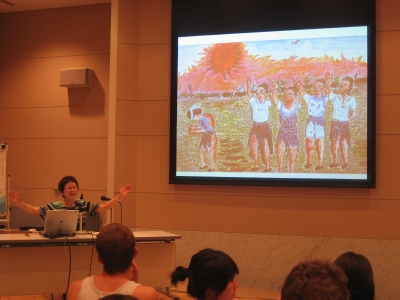
At first sight, Matsubara-san seemed no different from any other mid-aged or elderly woman. Perhaps one distinguishing factor was a sense of strong will power that seeped out through her rather heavy make-up and vigorous eyes with an uncanny sense of determination about them.

They say human beings have hundreds of facial muscles, but the facial expressions she showed during the forty-five minute speech seemed almost overly intense and vivid. She later mentioned that she was one among numerous A-bomb survivors that underwent a multitude of surgeries to hide away the scars. Whether that was one cause of those eerie expressions, I will never know.

The English that came out of her mouth did not amaze me (though it is quite unusual for Japanese women of her age) as much as the will power that produced it. Her graphic, eidetic drawings also clearly indicated her determination to share and pass on the utter horrors of the atomic bomb. In my eyes, this embodied the essence of art: a direct outlet for her emotions and a tool for communicating events and emotions that cannot be expressed in words.

We were very fortunate to be able to hear the experience of an A-bomb survivor in person, and I greatly appreciate Matsubara-san’s willingness to share an uneasy story to tell. At the same tie, Matsubara-san herself expressed a deep sense of gratitude toward one American woman in particular for her compassionate generosity in post-war Japan, when even the Japanese would step away from “contaminated” individuals like herself. In my understanding, such acts of kindness was what enabled Matsubara-san to gradually learn to accept and forgive what had been done to her life, and to devote herself to passing on the giving spirit to us.

Only later did I notice the remarkable connection of the lesson I learnt from studying the effects of the A-bomb in Hiroshima to our World Campus International Arigato Evento song. Yes indeed, it starts with “one to one”, and “everyone can touch someone”. Thanks to that kind American lady, I gained a valuable life-lesson from Matsubara-san. But this could go on infinitely… who shall I thank, that motivated the American lady’s act of kindness?

(Yuki Yoshida, Japan)

Unique Access to Japan!

close

Enjoy this blog? Please spread the word :)

  • Facebook
  • Instagram
  • YouTube
  • Twitter
  • RSS
  • Follow by Email