Category Archives: City Theme Activities

Hot summer festival!

Kappa-Festival

Hot summer day in Abiko Japan. The day of Kappa Festival right by the Abiko Train Station. This day was one of the last days of the World Campus – Japan Summer 2010 Tour and it was as busy or more busy than the first day.

Before i go into telling you what we did that day I have to explain what the Kappa Festival is right? or at least explain what a Kappa is, so here is the explanation: Kappa is a water creature, it looks like a very interesting combination of a frog with a chicken pick and a plate on his head.

The Kappa Festival has become one of the most important celebrations of the City of Abiko, they have everything from music performances which we were part of, food everywhere, there is of course a parade which we participated in and then it ends with a very cultural celebration at a park with bamboo candles everywhere, which we had the opportunity to help set up.

So, as you read, the Kappa Festival is just a celebration of life. World Campus – Japan participants not only had the chance to participate in it as a performers but we also helped with all the set up of the festival.

It was a great experience to see how people work all year long to plan this day, they also work really hard on the day of the festival to make sure everything happens as planned.

People ate, enjoyed each other’s company and celebrated the Kappa with a great Abiko spirit, which is now more than ever, a very international spirit.
Much more than hot water.

Tea Ceremony

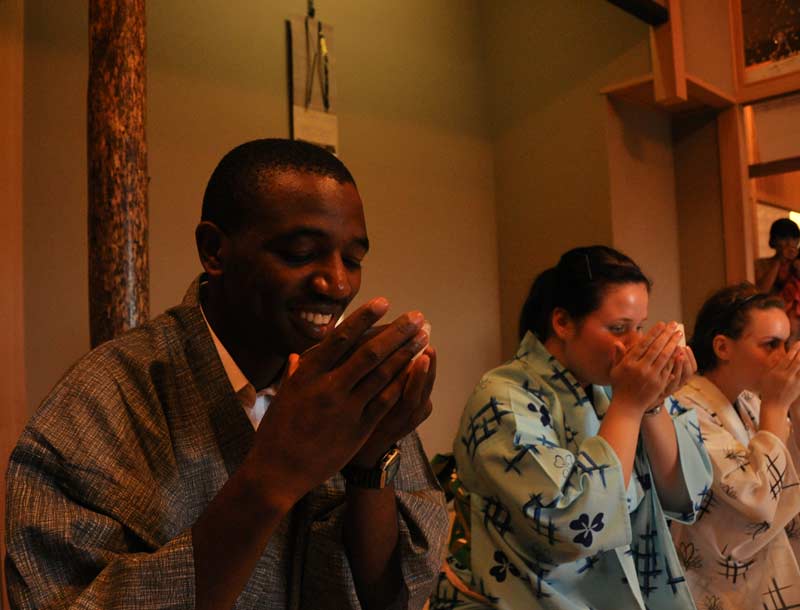
This was forsure a very cultural learning day in World Campus – Japan. We went from rehearsing our on performance for the Kappa Festival (which we will talk about on the next few posts) to learning a very traditional dance to hula classes. But the highlight of the day was… The Tea Ceremony!

For those of you that never heard about this Ceremony, here is a little explanation about it:

“The tea ceremony is a very special event in Japanese culture. The host spends days going over every detail to make sure that the ceremony will be perfect. There are various styles of tea ceremonies and it is recognized that every human encounter is a singular occasion that will never recur again in exactly the same way, and so every aspect of the tea ceremony is savored. The ceremony takes place in a room called the chashitsu. This room is designed and designated only for this ceremony”

The participants of World Campus – Japan had the opportunity to dress up with yukatas and learn about this very traditional way of serving tea that goes above and behond warming up the water and adding tea.

What if the world were an apple?

world as an apple

The Earth seems like such a large place, will we ever have too many people for Earth to produce the things we need to survive? How about the plants and animals that live here? Is there enough for all of us? How much of the Earth is actually available to produce the food we need and to clean up our wastes? What’s your guess; 100% of the surface, 50%, less?

Using an apple to represent the Earth; cut the Earth into four pieces. Now throw out three of the pieces that represent the oceans. Oceans make up 75% of the Earth’s surface area.

Slice the remaining piece of Earth in half and throw out one piece representing lands, such as deserts, that are inhospitable.

Slice whats left into four sections and throw out three of them. These represent areas that are too cold, too steep, or too rocky to produce food.

Peel the skin off of the remaining slice of the apple ad keep it, throw out the rest. This small amount of skin represents the Earth’s crust, the area that has enough topsoil to produce the food on which we all depend.

The Earth doesn’t seem quite as big anymore does it? Natural resources are limited and must be used wisely so that all of us can live on this small piece of Earth.

For more information on this subject go to:

http://www.easternct.edu/sustainenergy/education/documents/FootprintCommittmentandCalculator.pdf

What am i doing?

Environment-test

On this day we had the opportunity to learn a lot about the environment. As always in World Campus – Japan, the experience turned out to be way different than we expected. In the morning we were told we were going to learn about Yatsu. Yatsu is a place where different species of plants and insects live and its being preserved by an environmental group in the city of Abiko. We walked through the Yatsu and observed the area.

Once we got back we created different types of collages with material that we collected at the Yatsu and talked about each of them with our team. Then we played a fun trivia game to win points for our teams, the questions had of course an environmental focus.

We for sure learned things that we never expected to know, like the fact that a Styrofoam cup takes 400 years to decompose while an orange peel takes only six months. We also learned fun things like the fact that an average child uses 6000 diapers through his lifetime. 🙂 who would have known.

After all that it was time to do something more serious and an activity that was going to make us think about what we do every day to preserve or damage the environment. We took a test that tells you exactly how many worlds you need to sustain your lifestyle, and as we know, we only have one world! Check out this link, take the test and start thinking about what you do to yourself and to the environment every day.

http://www.easternct.edu/sustainenergy/education/documents/FootprintCommittmentandCalculator.pdf

We finish the environmental day with a very visual activity that we will talk about on the next post. Very interesting to know that if we think of the earth as an apple we would be doing less things to damage it.

Young spirits

Elderly-Home

In World Campus – Japan, the majority of the participants that travel are between 18 and 30 years old, even when our program doesn’t have age limit. With many young people around you all the time, you might think that you will get the best spirit and energy in the world, and sometimes is not like that at all, and i am about to tell you why.

On the day we went to visit Suzuran-en, we knew we were going to visit grandmas and grandpas from Japan, because Suzuran-en is an elderly home but the visit was completely different than we expected it to be.

Around 55 people with an age average of 88 years old taught us that day that age is not important to have energy and hope for the future. This residents spend their time doing many different activities guided by an amazing group of staff members that are not only there because is their daily job, but because is their passion. Their director inspires them to become better people every day and to care for the residents of the center.

On this amazing day we did activities like calligraphy, flower arranging, singing, dancing and many other activities. At the end of the day the residents did a performance for us with so much energy that the place was filled with a huge positive feeling.

We met, on this day, a women who is 106 years old and is still living and enjoying every minute of her life, she is still learning, admiring and getting excited for the small things in life and that was for sure a life lesson. We realized that sometimes we don’t have the energy to live 100% but we do have the opportunity to fix things and become better people for us and for others. They don’t have too much time but they for sure live every minute as it was the best minute of their lives.