Category Archives: City Theme Activities

A Home for Everyone

On Friday the 15th, the WCJ 2011 session II crew went to Jikei Hospital in Kumamoto Prefecture after a brief (and very, very warm) adventure at Kumamoto castle. For those in the know, going to a hospital an hour away might seem odd, as there are several hospitals in Arao all worthy of a visit. Jikei hospital, however, has something unique to the whole of Japan: a so-called Baby Deposit Box. A Baby Deposit Box, despite the oddly sounding name, is an initiative for the rights of babies in danger of being abandoned by their parents.

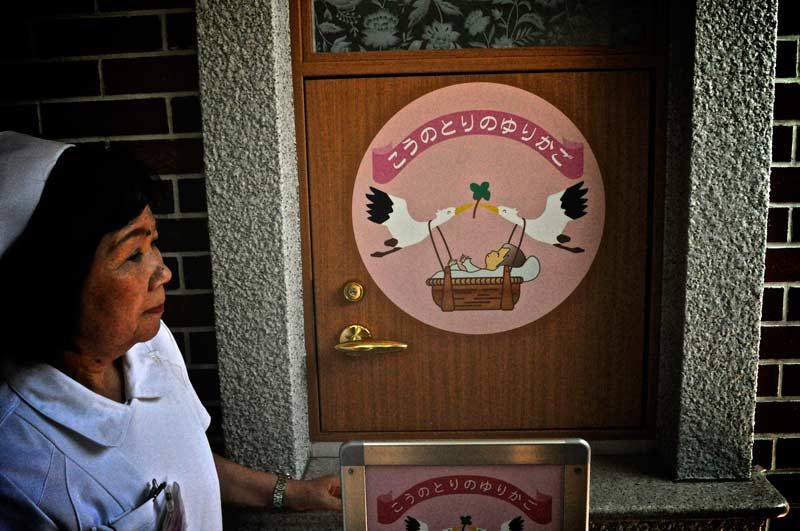
Stork’s Cradle


The set up is like this: there’s a hatch in the one of the hospital walls. The hatch reveals a cozy cot in which one can put the baby. The cot is lined with soft materials and the room is insulated to keep the baby warm. When the baby is put into the cot, an alarm sounds to alert a nurse with special training to pick up the baby and have it checked out by doctors. There’s also a camera for surveillance of the baby.


The initiative for the Baby Deposit Box, or Stork’s Cradle as it is called, was taken by Dr. Hasuda Taiji, former Chief Director of Jikei Hospital. After three baby deaths in the local community surrounding the hospital, the doctor was very distressed that his hospital couldn’t offer the babies and their families help. He was inspired by a trip he had taken to Germany, where there are many Baby Deposit Boxes, to make one in Japan, and despite some hardships the Stork’s Cradle was opened in 2007. Dr. Hasuda was not so concerned by the many controversies that arose but rather with the fact that children who otherwise would be abandoned should have a chance at life. For Dr. Hasuda, the children are, and will be, the first priority. And to date, 75 children have been given a second chance at life. Thank you very much Jikei Hospital for welcoming us all and sharing your time with us. Afterwards we had the chance to discuss in our group representing 9 countries how our culture and countries views programs like this and to hear so many different views and perspectives from around the world was really a unique experience.

(Alexandra Kristinnsdottir from Norway)

International Fair, 9 Cultures (Norway’s Table)

Norway Table


This last weekend we had a great opportunity to host an international fair at the Arao City Mall. Right now our World Campus Japan group represents 9 different cultures and countries and the 4 of us Norwegians were excited to represent Norway. I wasn’t too sure on how I could show Japanese people our Norwegian culture but it the challenge was great and it turned out to be quite fun and new for me. Alexandra, Joakim, Torunn and I (Ola) were the 4 Norwegians in the group and we had the idea to serve traditional Norwegian porridge, which surprisingly many of the Japanese people seemed to enjoy. Hiro the president of World Campus International, Inc. luckily has a Norwegian wife Kristinn and she had been kind enough to make it for us (because none of our host families had the right ingredients), it takes about two hours to make it from scratch so we were really thankful for her help and knowledge for knowing the ingredients!

Norwegian porridge


Lots and lots of people from the community showed up for the fair anywhere from older couples to somewhat over 100 kids! By the end of the fair almost all of the porridge was gone. We were also letting people taste the Norwegian liquorice, which not too many seemed to enjoy as much as the porridge. We all really enjoyed sharing our cultures, traditions and taste buds with the Japanese community here in Arao, we thank them very much for welcoming us and we learned a lot from their culture so it was great to be able to give back and it would be great to do it again sometime!


(Ola Johanness from Norway)

400 years later and still standing strong

Kumamoto castle


This week all of us had the opportunity to visit the historical castle of Kumamoto. This was an amazing experience because it showed all of us just how simple, yet beautiful Japanese architecture is. Even though the castle was over 400 years old, it is still in good shape and just as beautiful. When we went through the entrance of the castle, the walls were really tall and made of big black rocks that would be impossible for any person to climb (I think that the purpose). Even the watchtower was over 50 m tall and when walking through the low doors, passing through the small rooms and going up the really narrow and yet tough steps, you could really feel those 50 m. But it was all worth it, when we got to the top of the tower the view was the beautiful city and mountains of Kumamoto. Afterwards, we went to the restoration of another part of the castle. Even though the restoration was new, it had been restored so carefully, that you could almost feel the spirits of the samurais and how they’ve been walking though the underground part of the castle.

400 years later and still standing strong


When we finished the tour of the castle, we went outside where we met a Japanese guy dressed as a red samurai looking prepared to win a battle (we thought it was hot outside but after seeing this guy dressed in a full samurai uniform weighing around 70 Kilograms we now thought we were the lucky ones) also he was very polite in front of the girls, he even took the ladies hands and got on his knees as a polite gesture.

After all this experience was so indescribably beautiful, that the pictures just doesn’t reach the same level of beauty. It’s just one of those special places where you just have to see it through your own eyes. I did, and I would properly never discover this castle without WCJ. And for that I’m truly grateful.

(Nina Møller from Denmark)

Cooking with Iris at Miike Elementary

One of the most amazing experiences of the first session was going to Miike Elementary School in Omuta for 2 days. I was kind of nervous because I had very little experience with kids. I was especially nervous because the first class we taught was cooking class and we were asked to teach the children how to make a dish from our home countries. So the class was divided in two groups, Andrew would teach one group a Chinese dish and I taught the other group a Dutch dish. I decided to teach them how to make hutspot, a really easy but really Dutch dish to make!

Iris and Brandon teaching the kids


We started by cooking potatoes, carrots, and onions and then we mash them up and ate with sausage. The kids all paid good attention and I was really nervous because I am not the greatest cook and I’ve only made this dish twice in my life. After that, all the kids went to the stations and begin cutting the vegetables and preparing the food. I got to walk around and see the kids making the dishes and it was great to see them really enthusiastic and wanting to make it right.

Andrew from China teaching his dish


In the Netherlands we have a special kitchen utensil that we use to mash the vegetables, but, of course they don’t have that in Japan (at least I don’t think they do?) so they gave me a stick to use which looked a lot like a Taiko drumstick but I am sure it was just a cooking stick. Now the kids were really excited because it was time to mash the vegetables. After that it was now time to eat. I was so glad to see the kids enjoying the hutspot and I even thought it tasted like the one from home! Andrew from China also made a great dish that we really enjoyed.

Iris playing with the kids after eating


The next day, the class gave me a book made of thank you cards, which each kid wrote something nice on and a lot of kids wrote they like the dish and a few of them even said they would make it at their homes, how awesome. It was a really great experience, at first I was a bit scared and insecure but the kids were so welcoming and enthusiastic and they just loved the fact that I was there trying to teach them something. Thank you Miike School for the great experience!

(Iris Spruit from The Netherlands)

A Peaceful man with not such a peaceful past

The more I come to Japan, the more I understand the importance Japanese people give to PEACE. After going through events as hard and powerful as the Hiroshima and Nagasaki Atomic bomb, I think any country would take the word “Peace” very seriously.

This time we had the opportunity to listen the story of a Nagasaki A-Bomb Survivor. As a 15 year old at the time of the bombing, his point of view of the event was surely very innocent but very realistic. With 81 years old today, he feels very lucky to have lived through this unfortunate event in 1945 and is now one of the many people committed to spreading the word of peace.

Rianne and Iris with the survivor


After he retired from his job as a teacher in 1998, he decided to start sharing his experience as a survivor from the A-Bomb and have been doing it for 13 years. With more than 70 speeches every year, he believes, this is his way of informing people about the facts of the bombing but most important, this is the way he is teaching everyone who meets him that hate is not the answer.

He shared his experience with all of us in World Campus Japan for about an hour. The final words of his speech were very calm and simple but the positive energy he was giving to all of us was more powerful than any words… “Since I retired my job as a teacher, my job has been to spread the word of peace and I will continue to do it until the day I die”

World Campus Japan members with the Survivor


I was seating there, as I did last year, and again I was reminded of the importance of the work we do in World Campus Japan, learning about other cultures, knowing the whys of every person and every country, to be able to respect each other.

After finishing his speech he gave us time for pictures with him and questions, he hugged all of us and said I love you to many of us. What a great feeling to have met someone that has gone through so much and has such a great outlook in life.

Celi and Brandon with the Survivor


I believe this is the beginning of a new moment for the world and for young people that take the risk to step out of their comfort zone, putting themselves in other people’s shoes to truly understand each other. It is everyone’s personal effort what will make this world a better place. It is not easy but we have to start now to have the peace we all want for ourselves and for our communities around the world.

(Celiana Dolovitz – Education Manager in the Summer ‘11 Road Team)