Tag Archives: featured

Hospital day

Jikei-hospital-grp-photo

Day of the activity: June 18th, 2015

Today we went to the Jikei hospital where they have a so-called ‘baby hatch’, or more formally ‘the stork’s cradle’. It is a place where parents who are unable to care for their children can drop off the baby anonymously.

Before we went to the hospital itself, we had s meeting with a nurse whom had worked with the cradle for several years. She told us many emotional stories about women who couldn’t even tell their parents that they were pregnant, and had come to the stork’s cradle. I was quite surprised that the social stigma around pregnancy under the ‘wrong’ circumstances was still so powerful, and even more shocked and surprised when we were told that before the cradle was started, there had even been a problem with babies being abandoned and found dead.

When we came to the hospital, we were overwhelmed by all the cameras and journalists who were there for reporting on our visit. Apparently all the local TV stations, and at least one national newspaper, were there to cover our visit. We went to have a quick look at the hatch itself, and then we went inside to talk with one of the founders of the cradle.

It was very interesting to hear what he had to say about the effect that the cradle has had, but all the cameras made it somewhat uncomfortable. Afterwards, some of us went to take a closer look at the hatch, and even got to look inside. Inside was a letter with information for the child’s parents, and I was relieved to see that it is impossible to leave a baby without taking the letter.

Johannes Meyer (Norway)

Aileen Shorinji Kempo

Aileen Shorinji Kempo

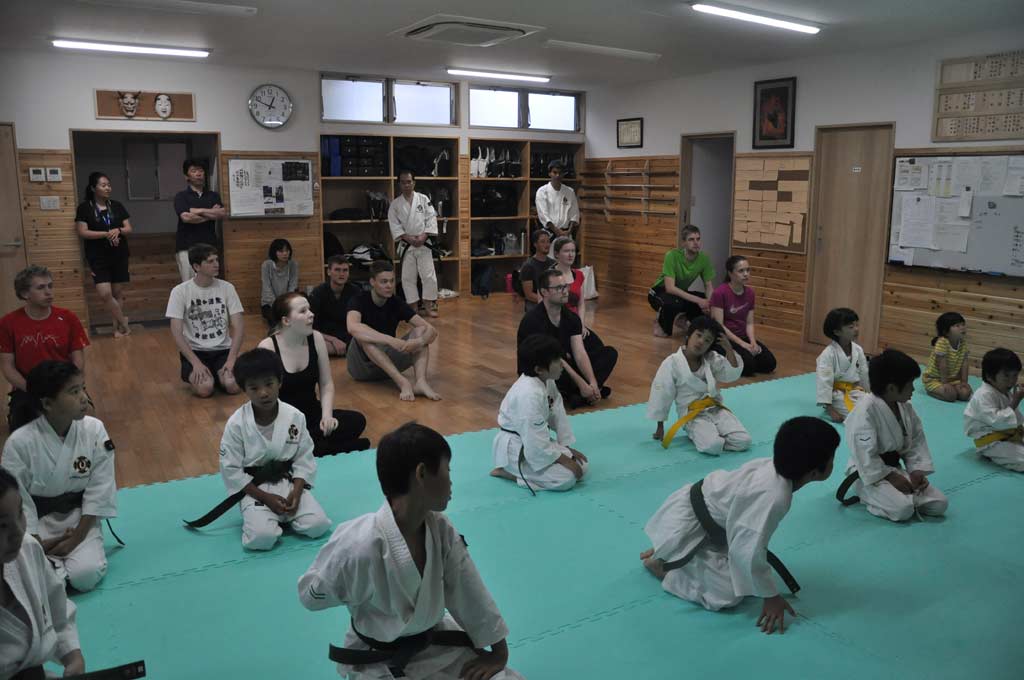
On the 13th of June we went to visit a Shorinji Kenpo Dojo. Since I have some experience with martial arts this was something I had been looking forward to doing and it didn’t disappoint. At first we learned about the history and philosophy behind Shorinji Kenpo. We learned how it had been created in Japan after the Second World War and how it really was a way of life. The teachers clearly had a passion for what they were doing.

When we had lunch we got to interact with some of the young students at the dojo. As always they had tons of energy and lots of smiles for us. After lunch we got our second chance to interact with the kids when the teachers taught us several different techniques and the kids helped us along.

I quickly found out that my experience with other martial arts didn’t help me much, but it was still really fun and quite the experience. It was really amazing to look at the children work and teach. Unlike us, even though they were only second and fourth graders, they clearly knew what they were doing.

After the dojo we had a short visit to a shrine where most of us got our fortunes and luckily mine wasn’t too bad. I ended my day with a BBQ party that my host family held with another host family and some friends. It was really nice and even though I was really tired from all the activities all day I really enjoyed the company and, of course, the food.

Aileen Hay (Norway)

Meeting a Survivor of the Atomic Bomb

A-bomb-survivor-grp-photo

Day of activity: June, 11th, 2015

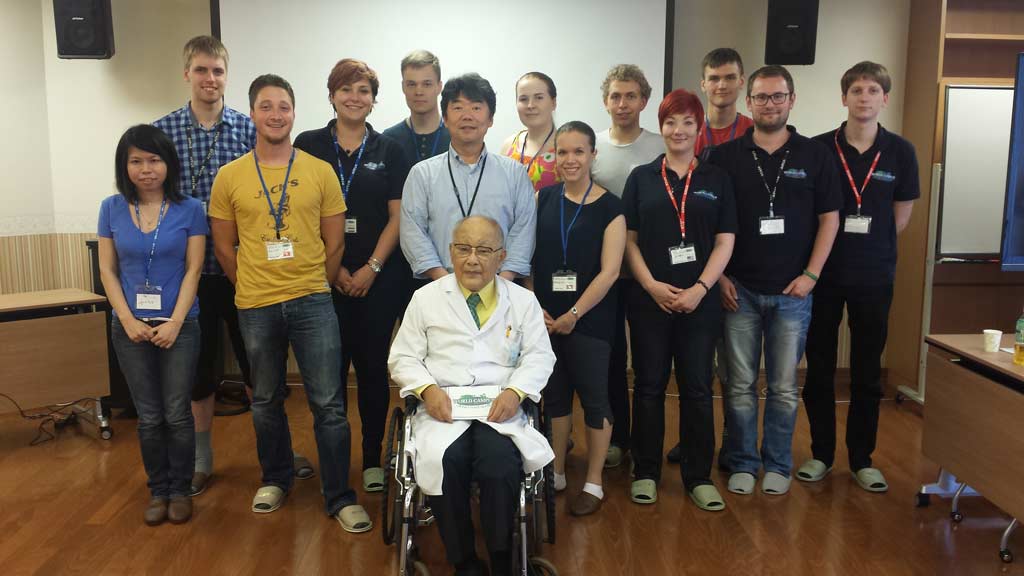
Today we got to meet an atomic bomb survivor.

Almost everyone (I hope) will, at some point, learn about the atomic bombs that were dropped on Hiroshima and Nagasaki through school/books/articles. At school you learn when it happened, what made the bomb so deadly, and what the death toll was, but today we got a small glimpse into what the bomb meant for the actual victims.

In the morning, into a classroom of sorts, in came a nice looking old man wearing a smile on his face. He introduced himself and then he turned on the projector and showed us pictures that he had painted based on what he remembers about the bomb.

He just stated facts, he didn’t need to resort to theatrics to pull at our heartstrings. His story of loss and hardship made me and several others cry during the presentation.

Eventhough his story was sad, it was a really valuable piece of history that not many get to hear. How his life changed instantly and how it still affects the survivors. I will be forever grateful to him for sharing his story with us.

Later on the same day, we visited the Nagasaki atomic bomb memorial museum. There were many actual artefacts that had been affected by the bomb such as glass bottles that had melted into clumps due to the sheer heat of the blast. The museum itself had also many interactive components which made exploring even more interesting.

I think that this all left an ever-lasting impression on me.

Helmiina Suuronen (Finland)

Visit of Omura City’s superintendent of the board of education

2015 Session1

Omura City, 10th of June, 2015

Today we visited Omura City’s superintendent of the board of education. The courtesy visit was the first “real” activity in our program, given that the previous day’s schedule was all orientation and preparing for the Arigato Event. Furthermore, the occasion was advertised as being quite formal, which made us quite nervous during the morning of our visit.

Despite our nerves, the courtesy visit was a success. After brief introductions we talked a lot about education in Omura, Japan and Japanese culture in general. The superintendent was very helpful and supportive when we talked about how we wanted to learn more, and more intimately, about Japanese culture. With his encouraging words we felt ready for the 12th of June and our first visit to a local elementary school.

After our conversation I gave the superintendent a present – a photo book – from Finland, where I’m from, as a token of our gratitude for how they had given us such a change to get to know more about the everyday life and culture in Japan. It was great to know how much people appreciated our desire to learn more about their culture and maybe share something from our own countries as well. As an added bonus, we also got cute Omuran-Chan stickers for each of us 🙂

Juuso Eemeli Myller

Unique way to experience Japan in Summer 2015

World Campus International, Inc. is offering an opportunity to take part in short-term, non-traditional experiential education programs in Japan. Participants can choose to sign up for one or more 3 week block programs in different regions across Japan participating in educational tours. While doing so, participants have the unique chance to gain Japanese and international experience as well as increase their personal and professional networks, all while enjoying the backdrop of Japanese culture, politics and business.

What does having this kind of “unique access to Japan” mean?

  1. A great chance to see Japanese cultural sites, eat delicious and exotic local foods and learn about Japanese traditions.
  2. A way to experience modern Japan through interactions with local politicians, business people as well as Japanese university and high school students.
  3. An opportunity to share your culture and volunteer your talents in structured activities with ordinary Japanese citizens, school children, disabled people and the elderly.
  4. An opportunity to experience an authentic Japanese lifestyle by staying with warm and welcoming host families.

In summer 2015, 3 sessions are taking place between June 8th and August 11th, 2015. More information and the application form can be found on the website. www.worldcampus.org. and also you can see participant reports on www.worldcampusblog.org.