Visiting Koutengu shrine was a great experience. Witnessing another culture’s religion is always great to see. The shrine’s garden area was great to see and going through the different procedures to enter the shrine was fun to do.
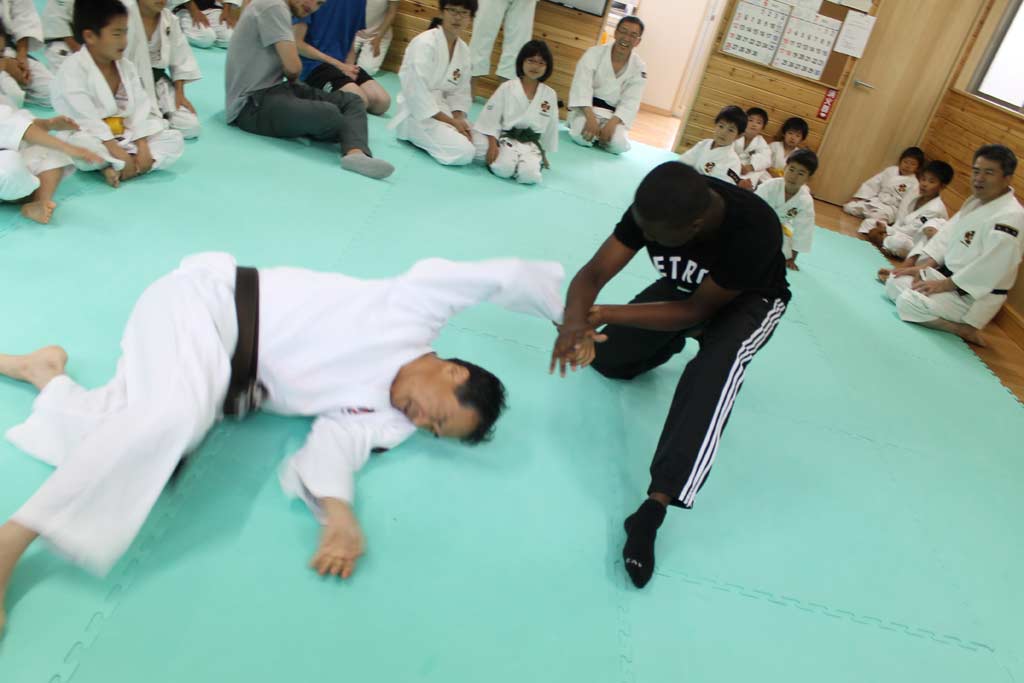
Shorinji Kenpo was also extremely fun. We learned the different pressure points to use to gain an advantage on an opponent point them into submission. I was even able to throw a few teachers around. All the students were much younger than us which made it even more fun when they taught us.
We had lunch at the dojo and were able to have conversations with each of them. All of them were kind and fun to interact with. I think that in the future I would love to maybe continue Shorinji Kenpo. I definitely wouldn’t mind trying another lesson or two. I hope we have a lot more fun with something like this again soon.
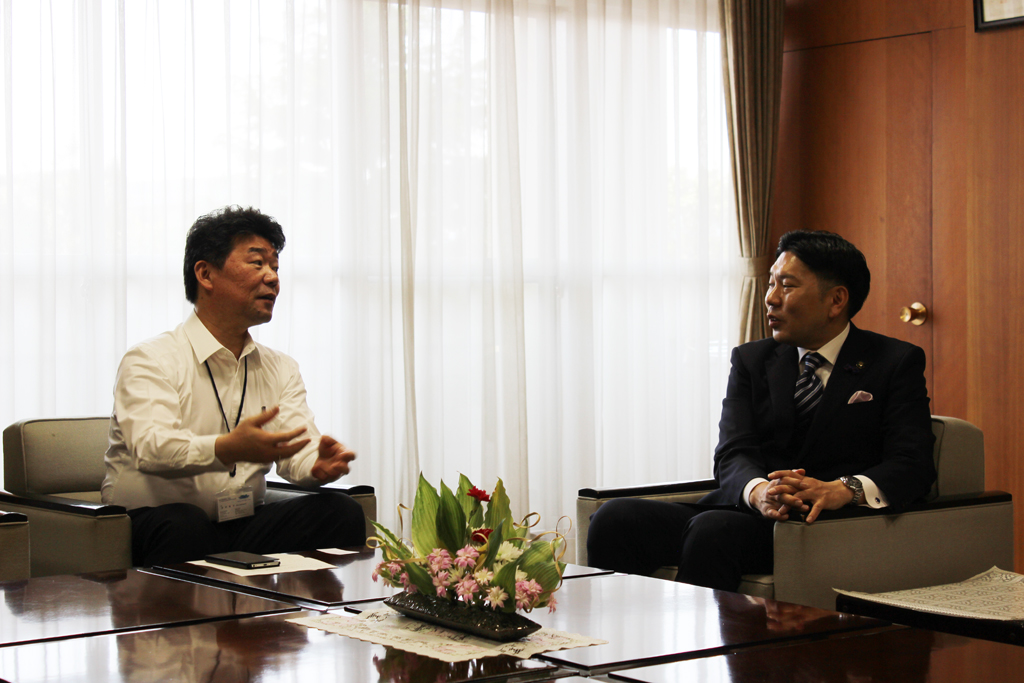
On Friday we met with the Mayor of Omura. He was a man in his mid thirties, really young – as everyone who lives here kept telling me – with a personable smile. Despite the heat he was dressed in a three piece suit, just a sign of what he’s willing to go through for his job. I was practically boiling in nothing more than a button down shirt. The Mayor, Mr. Sonoda, was surprisingly kind, especially for a leader of a city. He even brought a small gift for each of us. On any other day of this program the meeting would have been the highpoint without a doubt.
But on Friday, we also heard a speech from a survivor of the Nagasaki atomic bomb, and went to the Nagasaki peace museum. It’s the third time I’ve been to the museum, so I was a bit prepared, but even still it was hard for me to reconcile the cheerful atmosphere of the morning with an in depth explanation of the Nagasaki atomic bomb. It was like something from a different world.
Perhaps it’s just that I’m an American, but Mr. Kiyono’s, the atomic bomb survivor’s, speech was shocking. He told us how Nagasaki was reduced to rubble by the bomb, and ravaged by fires that lasted through the night, leaving only corpses in its wake. He also told us about his sister, who died of acute radiation poisoning. On her deathbed she wrote pages about how terrible America was in her diary. It’s just… hard to grasp.
If one thing, the museum only reinforced how terrible the bomb was. The exhibit called Nagasaki the “Atomic Wasteland ” with rooms full of debris, melted glass and twisted metal. I remember most clearly the walls of buildings that were scorched black by the heat of the explosion, save for where something else took the brunt of the blast. The silhouettes are still visible, and clearly retained the shape of a wooden ladder, a washing pole, a man. It was chilling.
Today I look around Nagasaki, and I see no hint of that “Atomic Wasteland”. The city is bustling, filled with beautiful buildings and kind people. There is no stigma associated with being American, despite what my country did to this city.
How, I wonder, is this the Nagasaki that was reduced to ash? Perhaps Fumi, Mr. Kiyono’s sister has the answer. Earlier I wrote that she filled her journal with anger, but leaving it at that would be doing Fumi a disservice. Later on, in the final pages she had the strength to pen, she left that hate behind. Instead, she wrote about her dreams for the future. How she hoped to recover, so she could marry a childhood sweetheart and raise a family.
Maybe, just like Fumi, the people here have decided to look towards the future, instead of staying mired in the past. Whatever the reason, I can only be thankful for people like Fumi, or Mr. Sonoda, or my host family, the Ogawas. People who are willing to forgive, instead of holding onto a grudge. Truly, the world is a better place for the people of Nagasaki.
If you come to Japan, I recommend a visit to Nagasaki, and the Peace Museum. Though I’ve been there before, I always feel like I learned something new, like, I have grown as a person. Oh, it’s sad, it’s sad. To quote a memetic American expression: “I cry every time.”
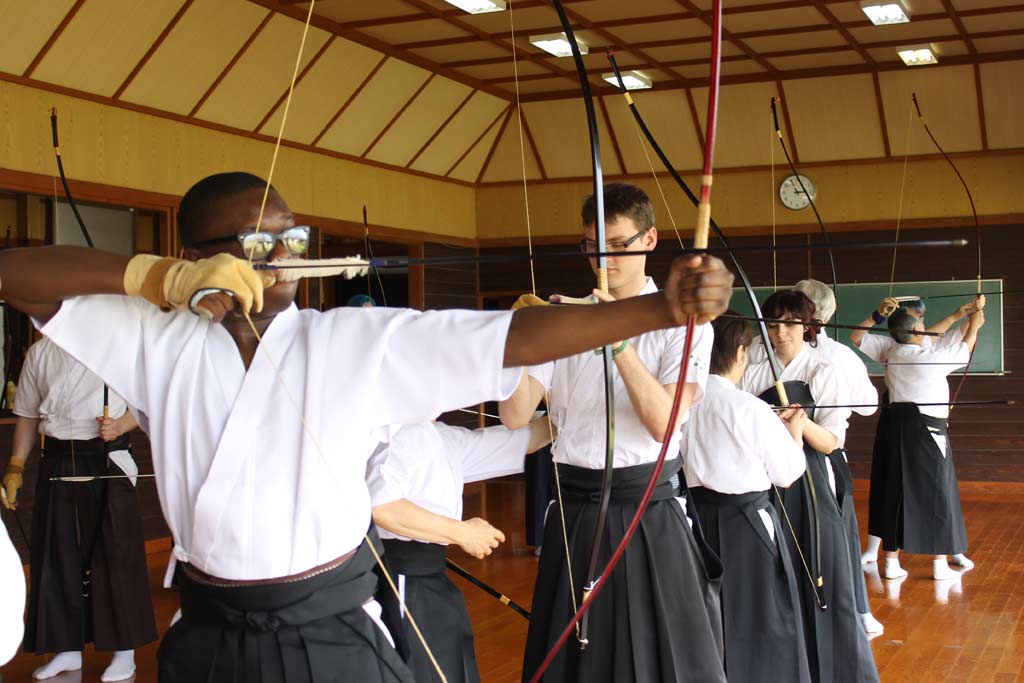
Today was a day well spent. I’ve done archery before, but never like this. I’ve never been more determined to hit a tree or a balloon than today. The feeling of accomplishment when I finally did was spectacular. I’ll explain why:
Kyudo has a rich history behind it and the Japanese people have made sure that it has stayed that way. The idea that every bow has a soul was also beautiful. Watching the dojo master’s demonstration was breathtaking to say the least. Then having a chance to do it myself was a whole different feeling. It didn’t matter if I won a prize or not, I just wanted to stay there and shoot as many arrows as my weak muscles would allow me to.
When one of the archers spoke about why they chose Kyudo, everything that they said I completely agreed with. That feeling of wanting to do better each time, the urge to continue even when you fail, not allowing failure to stop you but rather push you to do better tomorrow. Getting the chance to step in their shoes and really take on Kyudo was truly a luxury.
It’s hard to decide on part that was the most fun because everything about today was amazing. Those of us in World Campus Japan are truly lucky, having the chance that no other program gets to have. It’s an experience I will never forget. Maybe I’ll even continue with it.
Today was a day filled with interaction with students. The morning began with the arrival at Chuo Gakuin University, where we met up with a group of students from two universities. We had a day full of activities before us, so we soon began with the first one. Our first activity for the day was a lesson in using furoshiki. For those of you who have never heard of furoshiki before, it is a traditional Japanese wrapping cloth that is used to carry around all kinds of things.
After we all sat down in groups containing Japanese students and World Campus Japan members, we began very simply by making a small traditional hat.
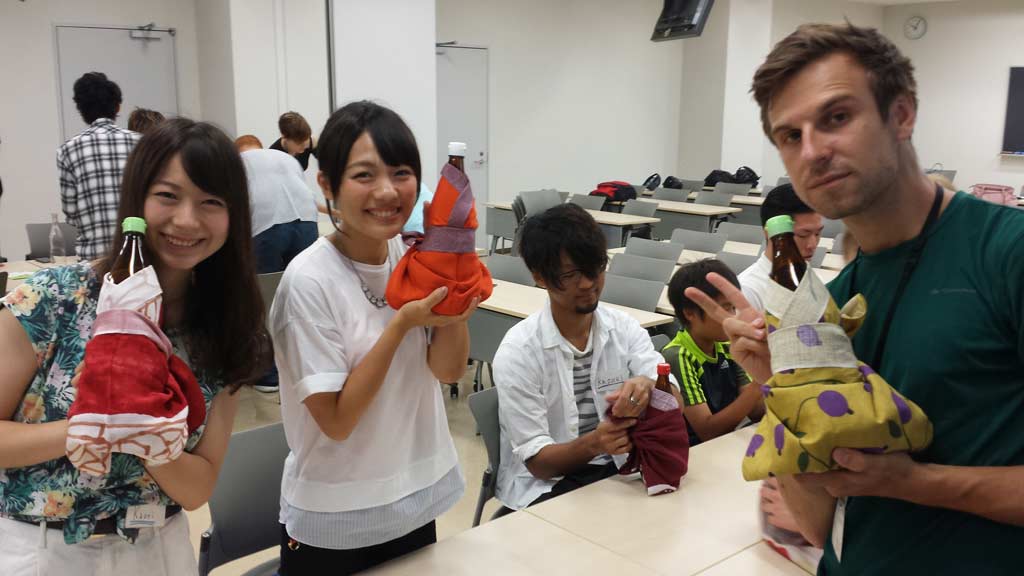
We then wrapped and knotted several things with the cloths. The one I liked most was wrapping a bottle in such a way that it looked like it was wearing a kimono. It looked very pretty and it was fairly easy to do.
Next time I give a bottle of wine as a present I will probably wrap it like this.
Even though I liked the bottle kimono the most, it was also the most ‘useless’ thing that we made. All the other things we wrapped had some use other than just being pretty. For example, we wrapped a watermelon into the cloth in such a way that made it very easy to carry (as far as a watermelon can be ‘easy to carry’). We also made a bag, a backpack, and we learned how to wrap 2 bottles together to make them easy to carry. I was surprised by how many things you can do with just a square cloth.
After the furoshiki workshop had finished, it was already time to have lunch. Together with the students, we put our own lunch together. The lunch consisted of a hotdog and a ham-and-cheese sandwich, which was a nice change from all the rice (although I have to admit that the average bento box tastes a lot better).
After lunch we went to play a few games, beginning with our very ‘mature’ variant of Jankenpon (rock-paper-scissors) called Evolution. The students had chosen a mimicking game and a game of musical chairs. It was a lot of fun. I think that playing games and having a workshop like the furoshiki one are very good ways to interact with the Japanese students since most of them speak very little English. And the games and workshop allowed us to interact and have fun together without having to talk a lot.
After the games it was already five o’clock and time to go back to our host homes. My little host sister of 12 had promised to show me kendo, and today she brought her uniform with her. She was so kind to let me try it on. But as expected the uniform reached till just underneath my knees.
Since the clothing is quite loose I could still easily put it on though, and while I was dressed in my small kendo uniform, my host sister taught me some kendo techniques. Sometimes it was hard to understand what she was trying to explain since her English is just as limited as my Japanese (which is almost non-existent). Even so, she tried really hard and it was a lot of fun to do.
It was already the last day of our stay here in Abiko, so this night my host family was obliged to fulfill their promise to take me to a ‘rotation sushi’ restaurant. They could not explain it very well, but basically it was a restaurant where most of the serving was done by a conveyor belt. You can order sushi (and other kinds of food) using a touch screen, and then your order would be brought to your table by the conveyor belt. It was a lot of fun to see all the different kinds of sushi and other food (and apple juice) pass you by on the conveyor belt. I never knew that there were so many things you could make sushi out of! Sushi knows a lot more variety here in Japan than in the Netherlands.
After our last dinner together we went back home. It was sad to think about our inevitable goodbye tomorrow morning.
Our Arigatou event in Abiko was different in several areas compared to the previous ones I have experienced. This Arigatou event was not a thank-you-and-goodbye event, as it usually is, but rather a welcoming event. The Arigatou event was already scheduled at the session’s third day. Another difference was the large amount of host family members who were able to come and watch the event. Including World Campus Japan staff and participants, the room in which the Arigatou event took place contained almost 120 people.
The Arigatou event started with an introduction of every World Campus Japan participant and corresponding family. The participant and a family member then had the chance to briefly elaborate on first expressions of each other, as well as the chance of wishing each other a good time together. After the introduction we had a potluck party. All hosting families had really put an effort into cooking and preparing the most delicious Japanese food for everyone present at the Arigatou event.
The actual Arigatou event started after the potluck party. We had prepared a show for all the host families, which included Japanese medley dances, country trivia quizzes, as well as games to make all people in the room participate in the event. With 120 people in the room that turned out to be a small challenge. In the end however, it all worked out really well. Later, some members of the host families even performed for us!
The arigato event was a huge success, not only for the World Campus Japan participants, but also for the host families.
Kristian Wolstrup (Denmark)
Unique Access to Japan!
Enjoy this blog? Please spread the word :)
Manage Cookie Consent
We use cookies to optimize our website and our service.
Functional
Always active
The technical storage or access is strictly necessary for the legitimate purpose of enabling the use of a specific service explicitly requested by the subscriber or user, or for the sole purpose of carrying out the transmission of a communication over an electronic communications network.
Preferences
The technical storage or access is necessary for the legitimate purpose of storing preferences that are not requested by the subscriber or user.
Statistics
The technical storage or access that is used exclusively for statistical purposes.The technical storage or access that is used exclusively for anonymous statistical purposes. Without a subpoena, voluntary compliance on the part of your Internet Service Provider, or additional records from a third party, information stored or retrieved for this purpose alone cannot usually be used to identify you.
Marketing
The technical storage or access is required to create user profiles to send advertising, or to track the user on a website or across several websites for similar marketing purposes.