Golfing with the Japanese!

Golf


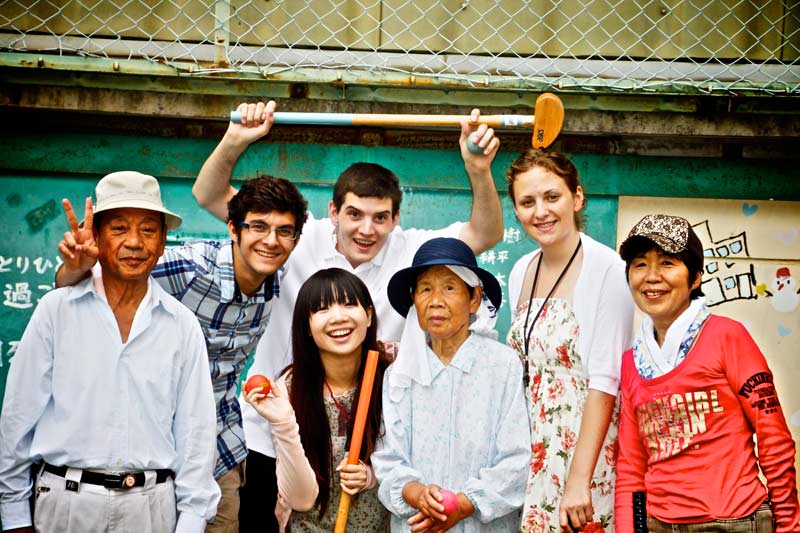
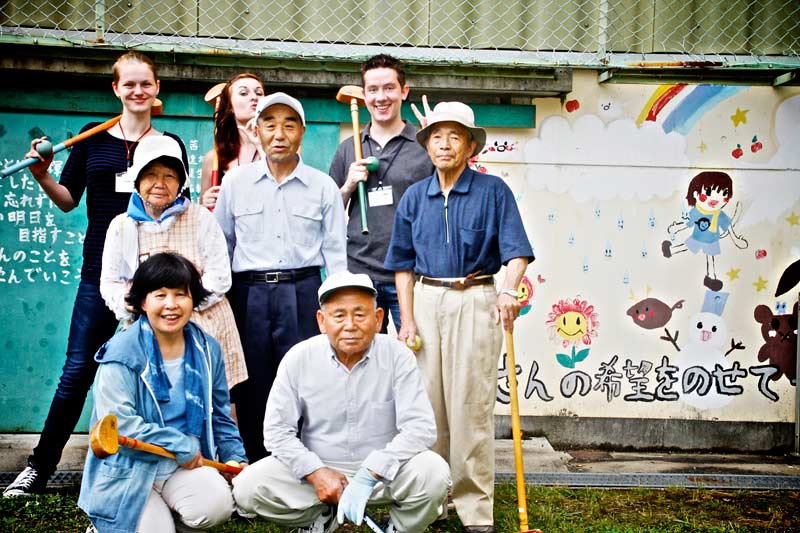
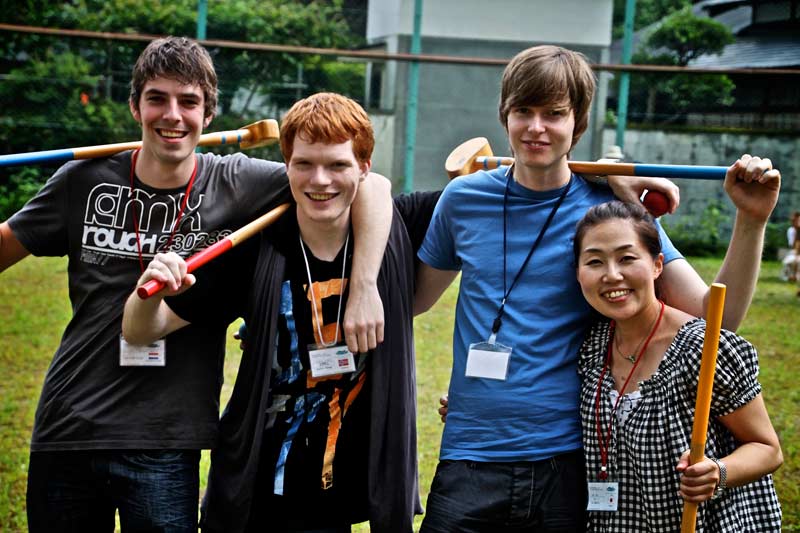
Last week when we heard we were going golfing for the day we didn’t really know what to expect and had some questions to our selves; when was the last time I golfed? Can I golf? What is Golf? But when we arrived we soon realized it was a Japanese’s style of ground golf and our teammates where mostly elderly people. So we were quite relieved that we had a chance to be good at the game. Then another surprise hit us when we saw how good the Japanese golfers were! We divided into 7 teams and played 18 holes of Japanese ground golf and it was just a blast and fun time with some really friendly people! 2 of us also got hole in ones and won some prizes!

Golf


Golf


Golf


Golf


Thanks for the fun time!

(Brandon Serna – External Relations Manager for Summer ‘11 Road Team)

A Samurai is only as strong as his sword

“While making the Katana for the Samurais we put all our heart and focus into it because we know the Samurai is putting his life on the line for his country and people.” This said by one of the sword makers while teaching us the art of making a katana.

One of the Craftsmen


Its always great to have the opportunity to see how anything is made, just so we can understand the work and effort that goes into them. I guess in this case I can say a little more work and effort go into making a Samurai sword, (Katana). I would say this because it roughly takes 3 months from start to finish to make and 5 years of training to learn the art of making them. In Arao we had the chance to visit a Dojo where lived craftsmen that make and train with Katana’s full time. It was very interesting to see their unique way of training and making the Katana’s.


Of course hearing about the swords history, purpose, and art was very interesting and exciting but we all couldn’t way to have the chance to hold the lite power of some of the world’s sharpest swords, and even get to use them! I think the expression on our faces said it all once they would hand us the sword and we realized just how lite they were! Overall the experience was full of history and interesting facts and being able to slice a blade and cut bamboo in half like it was butter was the perfect end! Thank you very much for welcoming us to your Dojo and teaching us the art of the Samurai sword!


(Brandon Serna – External Relations Manager for Summer ‘11 Road Team)

Japan has Temples like The Netherlands has bicycles


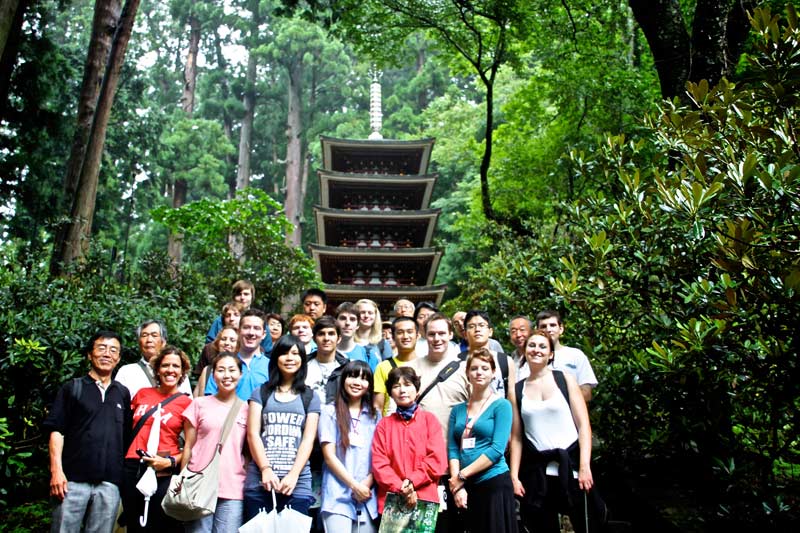
This week in Uda (possible the most beautiful city I’ve ever seen) we had the chance to see some of the cities amazing history. Our mission was to visit 3 temples in one day! One of which was Murou temple, one of the oldest temples in Japan. Some of the buildings were built in the 9th century and are still standing there. The temple buildings are surrounded by huge cedar trees close to a thousand years, an awe inspiring sight and a reminder of the power and beauty of nature. As we went up the roughly 500 stone steps towards the building on the top of the mountain the view became more beautiful with every step we took. Our guide explained the fine details of the statues of Buddha, their purpose and why they were arranged the way they were, it was very interesting. The 16 meter high pagoda, apparently the smallest outdoor pagoda in Japan can move like a snake, so even when a big earthquake occurs it will stay standing, and it has been standing for over a thousand years, and it is made out of wood! At the top some of the monks were having a ceremony, we were so lucky to be able to witness that.


(Frank Florris from The Netherlands)

A Home for Everyone

On Friday the 15th, the WCJ 2011 session II crew went to Jikei Hospital in Kumamoto Prefecture after a brief (and very, very warm) adventure at Kumamoto castle. For those in the know, going to a hospital an hour away might seem odd, as there are several hospitals in Arao all worthy of a visit. Jikei hospital, however, has something unique to the whole of Japan: a so-called Baby Deposit Box. A Baby Deposit Box, despite the oddly sounding name, is an initiative for the rights of babies in danger of being abandoned by their parents.

Stork’s Cradle


The set up is like this: there’s a hatch in the one of the hospital walls. The hatch reveals a cozy cot in which one can put the baby. The cot is lined with soft materials and the room is insulated to keep the baby warm. When the baby is put into the cot, an alarm sounds to alert a nurse with special training to pick up the baby and have it checked out by doctors. There’s also a camera for surveillance of the baby.


The initiative for the Baby Deposit Box, or Stork’s Cradle as it is called, was taken by Dr. Hasuda Taiji, former Chief Director of Jikei Hospital. After three baby deaths in the local community surrounding the hospital, the doctor was very distressed that his hospital couldn’t offer the babies and their families help. He was inspired by a trip he had taken to Germany, where there are many Baby Deposit Boxes, to make one in Japan, and despite some hardships the Stork’s Cradle was opened in 2007. Dr. Hasuda was not so concerned by the many controversies that arose but rather with the fact that children who otherwise would be abandoned should have a chance at life. For Dr. Hasuda, the children are, and will be, the first priority. And to date, 75 children have been given a second chance at life. Thank you very much Jikei Hospital for welcoming us all and sharing your time with us. Afterwards we had the chance to discuss in our group representing 9 countries how our culture and countries views programs like this and to hear so many different views and perspectives from around the world was really a unique experience.

(Alexandra Kristinnsdottir from Norway)

International Fair, 9 Cultures (Norway’s Table)

Norway Table


This last weekend we had a great opportunity to host an international fair at the Arao City Mall. Right now our World Campus Japan group represents 9 different cultures and countries and the 4 of us Norwegians were excited to represent Norway. I wasn’t too sure on how I could show Japanese people our Norwegian culture but it the challenge was great and it turned out to be quite fun and new for me. Alexandra, Joakim, Torunn and I (Ola) were the 4 Norwegians in the group and we had the idea to serve traditional Norwegian porridge, which surprisingly many of the Japanese people seemed to enjoy. Hiro the president of World Campus International, Inc. luckily has a Norwegian wife Kristinn and she had been kind enough to make it for us (because none of our host families had the right ingredients), it takes about two hours to make it from scratch so we were really thankful for her help and knowledge for knowing the ingredients!

Norwegian porridge


Lots and lots of people from the community showed up for the fair anywhere from older couples to somewhat over 100 kids! By the end of the fair almost all of the porridge was gone. We were also letting people taste the Norwegian liquorice, which not too many seemed to enjoy as much as the porridge. We all really enjoyed sharing our cultures, traditions and taste buds with the Japanese community here in Arao, we thank them very much for welcoming us and we learned a lot from their culture so it was great to be able to give back and it would be great to do it again sometime!


(Ola Johanness from Norway)

Unique Access to Japan!

close

Enjoy this blog? Please spread the word :)

  • Facebook
  • Instagram
  • YouTube
  • Twitter
  • RSS
  • Follow by Email