Tag Archives: City Theme Activities

Arrival day in Abiko!

Naginata experience

Day of activity: July 30th 2015

After a short eight-minutes trip from Toride to Abiko, the new city we are staying at, we were welcomed by the lovely LOC (Local Organizing Committe)-members of this town.

They made us familiar with our new surroundings by showing us where Abiko is situated and giving us some general information about the city, while they were at the same time explaining about its cultural aspects. In addition we met one of the mascots of Abiko city. I was so lucky and genki when they told me that I could wear his costume afterwards! It was so much fun and sort of awkward running around with the costume on, getting some pictures with friends while you are sweating like crazy since it gets so hot in that outfit. Afterwards we had lunch with the local people, which turned out to be really fun since they were really open-minded and not shy at all. They would walk up and talk to us, so we had some nice little conversations going on.

After a short ice-cream and ‘puru-puru’ (pudding) break (^.^ i love puru-puru), we got to experience one of the many Japanese martial arts, called Naginata. Not only would they perform for us, but we even got to learn some pretty cool moves and hitting techniques with our wooden spear-sticks (is that even a word?). They even brought along some presents for us which was really nice of them.

Next up was Taiko, also called Japanese Drum playing. The group that played for us, consisting of people of all ages, played 4 different songs with all kinds of rhytm patterns. Afterwards we got the opportunity to play the drums ourselves while the others were ‘dancing’ around in a circle. (we were all looking like potatoes)
The day ended with a welcome ceremony where we finally got to meet our host families and we eventually could go home and spend some time with them 🙂

Thomas Theis (Luxembourg)

Karate experience in Toride!

Karate experience

Day of activity: July 28th 2015

So today it was time for a Japanese Culture Experience… Specifically for me, Marie and Carla: karate! A Japanese martial arts sport I once practiced when I was very young.

One of the kind members of the LOC (Local Organizing Committee) drove us to a sports centre where we would soon meet our sensei. We changed into the thick white cotton uniforms that were given to us, and we even got to wear a black belt! (The white belts were too small… I guess kids start young in Japan!) We entered the traditional-looking training room and were surprised to find a group of about 20 children staring at us with big eyes.

After introductions by the sensei, and paying respect by bowing, we started the warm-up. Many punches and kicks in perfectly formed lines later, it was time for stretching. We teamed up in pairs of two, and each one of us joined one of the kids to help eachother stretch further. We were surprised to see how flexible they were!

At one point, when stretching the legs outwards while sitting crossed-legged, the sensei wanted us to stand on the knees of the children to stretch them further! Doom had come to the innocent children who had teamed up with us…or at least we thought so. After asking “Daijoubu?? Hontouni daijoubu?” many times, my tiny partner didn’t even flinch when I stood on her knees. Better yet, she was laughing at Carla’s shocked face!

After the stretching our bodies were ready. The children got out punching-pillows and the training started. Front and sidekicks were the main things we practiced, and I have to say it was rather fun to do again.

After a quick sip of sportsdrink, it was time for the kata; a fixed order of several defensive techniques and attacks. We would have to learn this kata by heart in only half an hour, as we were going to perform this at the arigatou event. Time went by quickly, and we were able to remember most of the kata.

Last but not least, we once again bowed to the front of the room twice to pay respect to both the teacher and the ‘karate environment’ and said our goodbye’s to the children and the sensei. We were so lucky to have them all joining us the next evening at the arigatou event.

It was a great experience. I really liked how respectful everyone was to each other and helped each other improve. Personally it was also really fun to re-experience karate. I kind of miss it now. Who knows, I might try it again once I’m back in the Netherlands!

Fleurtje Meijer (The Netherlands)

Our first activity day in Isehara

AMADA exhibition

Day of activity: July 15th 2015

Today we did a bunch of different stuff! First, we visited Oyama elementary school, where we were met by its few- but extremely motivated- students and teachers. First, we taught them various things about our own countries. Then, we did a game where you introduce yourself to as many people as possible and collect a signature from every person. Next, we tried a traditional wooden toy that you send spinning by wrapping a rope around it and pulling back fast on it. The two girls who taught me made it look easy, but trust me: it wasn’t! I still had a lot of fun though!

Our next activity was a visit to the AMADA company, whom specialize in making machinery for cutting into metal plates. I’m not usually that interested in industrial machinery and such things, but the visit actually turned out to be really interesting. The precision and speed of the machines was really impressive, and we actually got a much closer look at them in action than I ever thought we would. The best part for me though (and I suspect for many of the others too) was going to the large exhibition room where special art pieces made with AMADA’s machines are on display. They were often made by students, and many of them were incredibly detailed, thanks to the use of laser-cutting and the like.

After our tour of the AMADA facility, we went to the Kikawa sake brewery. Located in a nondescript residential area, it’s the kind of place that you would easily miss if you just happened to walk by. But once inside, you could immediately tell that this place is special. They still make much of their product the old fashioned way, relying on a mix of ancient techniques and old trusted machines. We started our visit by watching a short video about sake brewing. Then we got a guided tour by the brewmaster himself, a man who is clearly very passionate about his work. Once the tour was over, we all got a small bottle to take back as a sample if we so pleased. I drank it with my host family, and I was very pleased!

So to summarize: school visit, industrial machinery, and sake- all in one day! It was an awesome day.

Simon Presley (Denmark)

Watching the Japanese archery club at Kansai University

20150702_111702

Day of activity: July 2nd, 2015

First came the morning meeting, like any other morning meetings we were lightly briefed as of what today might bring, like we got basic information of where, what and when, but we were also told that there was a change in the schedule. We got the honor of watching the Japanese archery club at Kansai University in action. As we grabbed our “best friends” – our schedule and pen – we wrote the changes of the schedule, as instructed.

After arriving we met up with a couple of guides of the Kansai University. The entrance was a huge gate that also looked like it also functioned as a bridge. There were also huge buildings everywhere, like the library which is supposed to be the oldest building of the university. The guide explained to me that there are about 35000 students attending, whereof 700 of them are foreign exchange students. The majority of the exchange students were from around Asia, most of them China and South Korea.

We took an elevator and walked around a bit, but in the end we were lead to a classroom. The Kansai University representative was standing there ready to have a presentation, which would have me view Japanese university students in a new light. But first of all, she spoke English like a Native American, supposedly because her husband is one. I think one of the things that surprised me the most was the fact that in Japan, over 70% of the students have a part time job. It is often not to pay for living expenses or tuition fee, but in order to get the hang of how society works in japan. In order to accustomate, apart from the part time jobs, there are club activities as well, and with these activities they learn about the hierarchical system of japan, starting by forming senpai – kouhai bonds.

The saddening part was finding out that in Japan, the interest in living outside the country is dwindling. Most of the Japanese people don’t take as much interest as they could have, and therefore there aren’t many that travel outside the country. At the same time the fertility rate in Japan isn’t a sustainable one, so there are fewer members of the newer generations, and thus more seats at the university that might be empty in the near future if nothing is done.

One of the solutions of filling up the seats of the universities, are the contracts Kansai University has formed with other universities across the world, including Sweden, Denmark, Holland- and if I play my cards right, soon Norway as well. The Japanese students do have interests in short time stays and exchanges with other countries, which compared to the long term programs is getting increasingly popular.

The presentation went by pretty fast, and during and before it we were introducing ourselves to the Japanese students who had cared to join us for the program we had for today at the university. We were split into 6 groups, where each of the groups were accompanied by a couple of Japanese students that tried their best to explain, and answer our questions. After the presentation, the students and us were lead to the Kyubu, the Japanese archery club. We were lucky enough to see a real Japanese traditional archery ceremony, performed by a girl all by herself, after which the team captain had held a speech welcoming us there. It was an amazing experience. The archery club practices on targets that are roughly 28 meters away, and watching her perform such a beautiful ceremony, made our blood rush and made us want to try for ourselves. The archery club gave us the chance to try out Japanese archery, but on the condition of us playing it safe, as it is possible for people to die if one isn’t careful. Just so you know I did hit the target! That was 5 meters away… 2/5 times… barely.

Well that’s about it, it was very fun, and Im thankful to Kansai University for having us! Arigatou gozaimasu!

Azzam Ahmad – 19 – Proud participant of WCJ
(Norway & Pakistan)

Coal mining and Katanas in Omuta and Arao!

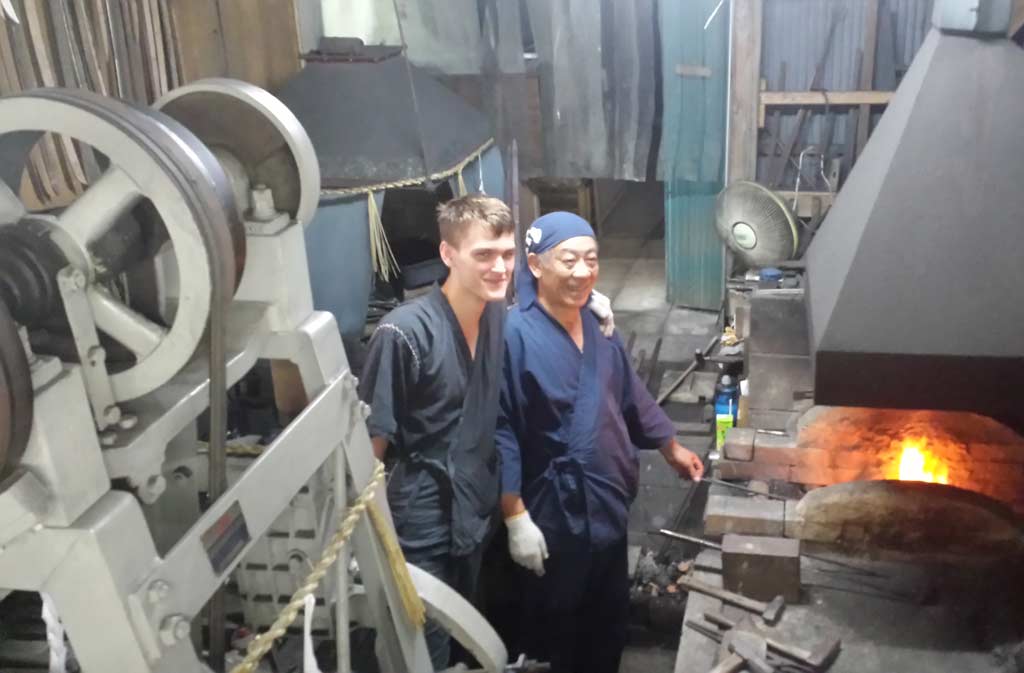
Isak with the smith

Day of activity: June 25th, 2015

Today we had two very different experiences. First, we went to the mining museum in Omuta to learn about the important role the city played in Japan’s industrialization. We learned that Omuta is blessed with an abundance of high quality coal, and as such it was perfectly suited for providing the fuel Japan needed for its industrialization efforts. The transfer of technology from the West to the East is something that the Japanese are proud to have been a part of, and since we don’t learn much about it in the west, it was quite interesting. The mining sites are a candidate for becoming a UNESCO world heritage site because of the unique role they played in the history of the world.

Our guide in the museum was himself a former coal miner who could tell us more about modern mining techniques in Japan as well, and he was very enthusiastic about teaching us what he knew.

After spending some time at the local mall eating lunch and shopping, we went to meet with a katana swordsmith. With his 37 years of experience (he is currently 62) he was able to teach us much about the difficult art of making a katana sword. The metal folding process is especially important, since Japanese iron is normally made from iron sand which produces a material that is not necessarily well suited to weapon making.

After talking with the swordsmith, we were instructed on how to cut a wet, rolled up, tatami mat in half using a katana. Most of us failed on our first attempt, but I and several others were able to make a clean cut by our second attempt.

Simon Presley (Denmark)