Category Archives: 訪問地

National Diet Visit 2015

National diet

Day of activity: August 5th 2015

On the way from Abiko to our new host families in Tama, we made a stop at the National Diet building. This is the place where the people’s political representatives gather. It is similar to a parlament in Europe.

After a guided tour through the building, including the emperor’s chambers and the main meeting room, we had a chance to actually meet one of the people’s representatives. He was Mr. Kado from the Liberal Democratic Party.

We asked several questions. One of them was concerning his solution for the growing urbanization. Because young people go to the big cities, it leaves the elderly out in the countryside, with no one left to take care of them.

We were also curious about the coming summer olympics in Tokyo. More specifically, the games will bring a lot of foreigners to the country. At this point in time, the Japanese language skill and cultural understanding might not be sufficient to adequately host so many foreigners.

So, we asked Mr. Kado how he thinks this problem will be solved.

His answer included the belief in technological advancement in instant-translation devices, but also the fact that an influx of tourists (although mostly Asian)
could help the Japanese shed the idea of a secluded society (one that still lingers since the end of the Edo era).

Personally, I would have liked to hear some attempt to make the Japanese interested in going abroad themselves, instead of counting on the people of other nations to come to Japan.
Nevertheless, it was interesting to hear his opinion.

After our meeting with Mr. Kado, he was kind enough to pose for a group photo with us. A few minutes later we were back on track to meet our new host families in Tama…

Wim Naessens (Belgium)

Our last day in Abiko: Chou Gakuin University

Furoshiki experience

Day of activity: August 4th 2015

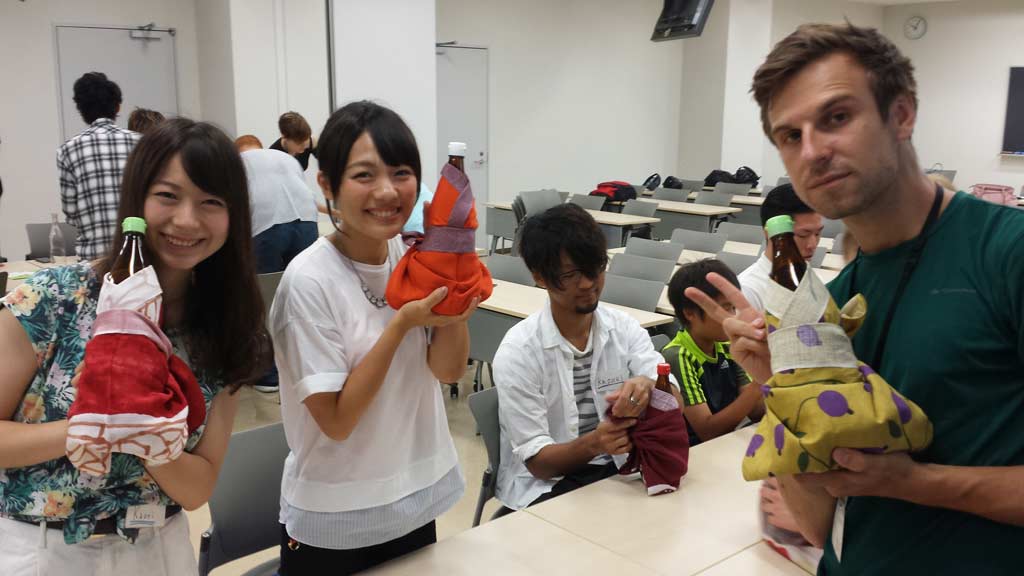
Today was a day filled with interaction with students. The morning began with the arrival at Chuo Gakuin University, where we met up with a group of students from two universities. We had a day full of activities before us, so we soon began with the first one. Our first activity for the day was a lesson in using furoshiki. For those of you who have never heard of furoshiki before, it is a traditional Japanese wrapping cloth that is used to carry around all kinds of things.

After we all sat down in groups containing Japanese students and World Campus Japan members, we began very simply by making a small traditional hat.

We then wrapped and knotted several things with the cloths. The one I liked most was wrapping a bottle in such a way that it looked like it was wearing a kimono. It looked very pretty and it was fairly easy to do.

Next time I give a bottle of wine as a present I will probably wrap it like this.

Even though I liked the bottle kimono the most, it was also the most ‘useless’ thing that we made. All the other things we wrapped had some use other than just being pretty. For example, we wrapped a watermelon into the cloth in such a way that made it very easy to carry (as far as a watermelon can be ‘easy to carry’). We also made a bag, a backpack, and we learned how to wrap 2 bottles together to make them easy to carry. I was surprised by how many things you can do with just a square cloth.

After the furoshiki workshop had finished, it was already time to have lunch. Together with the students, we put our own lunch together. The lunch consisted of a hotdog and a ham-and-cheese sandwich, which was a nice change from all the rice (although I have to admit that the average bento box tastes a lot better).

After lunch we went to play a few games, beginning with our very ‘mature’ variant of Jankenpon (rock-paper-scissors) called Evolution. The students had chosen a mimicking game and a game of musical chairs. It was a lot of fun. I think that playing games and having a workshop like the furoshiki one are very good ways to interact with the Japanese students since most of them speak very little English. And the games and workshop allowed us to interact and have fun together without having to talk a lot.

After the games it was already five o’clock and time to go back to our host homes. My little host sister of 12 had promised to show me kendo, and today she brought her uniform with her. She was so kind to let me try it on. But as expected the uniform reached till just underneath my knees.

Since the clothing is quite loose I could still easily put it on though, and while I was dressed in my small kendo uniform, my host sister taught me some kendo techniques. Sometimes it was hard to understand what she was trying to explain since her English is just as limited as my Japanese (which is almost non-existent). Even so, she tried really hard and it was a lot of fun to do.

It was already the last day of our stay here in Abiko, so this night my host family was obliged to fulfill their promise to take me to a ‘rotation sushi’ restaurant. They could not explain it very well, but basically it was a restaurant where most of the serving was done by a conveyor belt. You can order sushi (and other kinds of food) using a touch screen, and then your order would be brought to your table by the conveyor belt. It was a lot of fun to see all the different kinds of sushi and other food (and apple juice) pass you by on the conveyor belt. I never knew that there were so many things you could make sushi out of! Sushi knows a lot more variety here in Japan than in the Netherlands.

After our last dinner together we went back home. It was sad to think about our inevitable goodbye tomorrow morning.

Yolande Schuijtvlot (The Netherlands)

Our day at Ryusenji Temple

Shakyou experience

Day of activity: August 3rd 2015

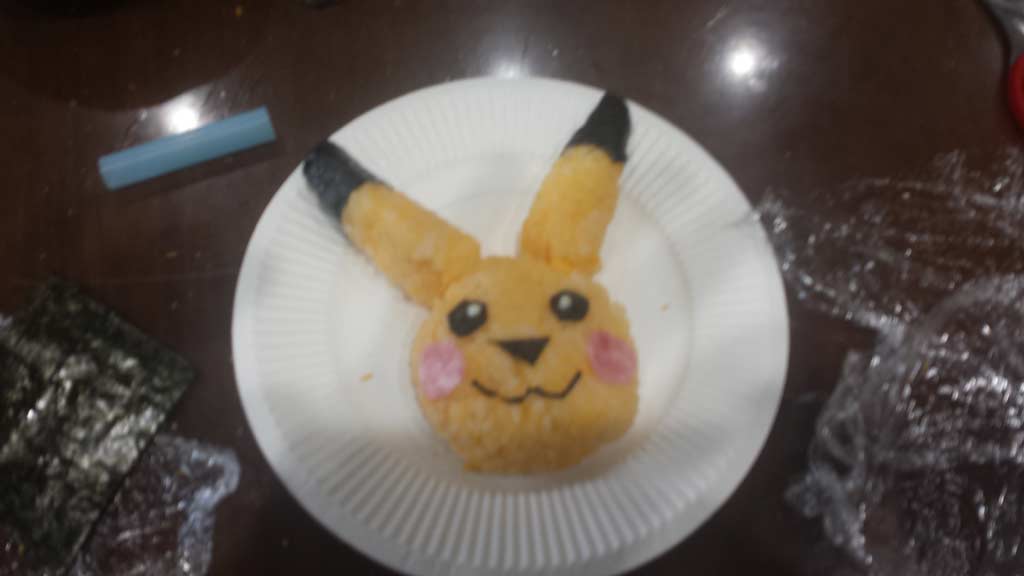
Today we went to Ryusenji Temple. They said it was smaller and less ornate than some of the more famous temples, but I was still really impressed! At the temple we met some preschool kids, and we got to make fans with them. I don’t speak Japanese, so there was obviously a language barrier, but we could still help each other with the glue and admire each other’s drawings that we made on the fans! We also had lunch with them, and the World Campus Japan members had brought bentos from “home”. I was very excited to see that my host mom had made a Pikachu face out of egg and seaweed! It was very cute, and I really appreciated the effort she put into it.

After lunch, we got to try copying a Buddhist text with ink and brush. I’m pretty sure whatever I wrote is not legible to any Japanese person, but sitting there concentrating on copying each stroke made me feel very relaxed, so I enjoyed it very much despite the end result.

Our last activity for the day was kendama, a type of toy that really requires a lot of skill. Our instructor was part of the Japanese Kendama Association, and it showed in how he handled the kendama. He taught us some “basic” tricks, and even though he made it seem easy, it was really difficult to do! It requires a huge amount of practice. It felt a bit silly to stand there bouncing, trying to do tricks with a wooden toy, but it was super satisfying when you actually managed to do it. I will definitely get my own kendama to practice with back home!

Ingeborg Helen Langli (Norway)

Arigatou event in Abiko

Abiko Arigato event

Day of activity: August 1st 2015

Our Arigatou event in Abiko was different in several areas compared to the previous ones I have experienced. This Arigatou event was not a thank-you-and-goodbye event, as it usually is, but rather a welcoming event. The Arigatou event was already scheduled at the session’s third day. Another difference was the large amount of host family members who were able to come and watch the event. Including World Campus Japan staff and participants, the room in which the Arigatou event took place contained almost 120 people.

The Arigatou event started with an introduction of every World Campus Japan participant and corresponding family. The participant and a family member then had the chance to briefly elaborate on first expressions of each other, as well as the chance of wishing each other a good time together. After the introduction we had a potluck party. All hosting families had really put an effort into cooking and preparing the most delicious Japanese food for everyone present at the Arigatou event.

The actual Arigatou event started after the potluck party. We had prepared a show for all the host families, which included Japanese medley dances, country trivia quizzes, as well as games to make all people in the room participate in the event. With 120 people in the room that turned out to be a small challenge. In the end however, it all worked out really well. Later, some members of the host families even performed for us!

The arigato event was a huge success, not only for the World Campus Japan participants, but also for the host families.

Kristian Wolstrup (Denmark)