All posts by Thomas Greve

The Thank-you Event (Arigato Evento) in Kumamoto City

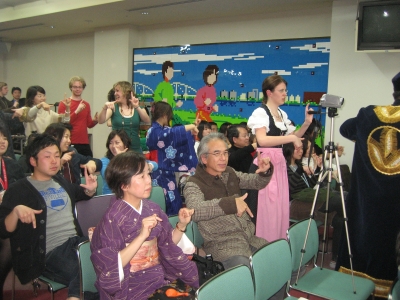
In every city we visit, World Campus — Japan participants present a small performance called The Arigato Evento. As an alumnus, and a member of the production team, this event is very exciting for me, and also for the families, many of which are hosting World Campus — Japan participants for the first time. The show begins with a small multimedia introduction, after which, the participants enter to an energized crowd.

The participants spend a few minutes dancing and interacting with the audience before moving to the stage. Once there, the fun really begins, as each of the 14 countries represented offers a small cultural presentation, ranging from a slideshow, to live music, to a story written in Japanese. At the end of the presentations, a host family is called to the stage and asked a few questions about their stay with the World Campus — Japan participant.

In Kumamoto city, the Fukushima family was called to the stage, they happened to be my host family, and had wonderful things to say during their interview. Once they exited the stage, I read to them a small speech I prepared, in Japanese, thanking them for being such a welcoming and kind family.

An American Sign Language song continues the show, which is very popular with the crowd because it is a song most of the communities have heard. Next we have a Japanese Medley, which includes 5 very well known Japanese songs. We have soloists, dancing and a lot of interaction with the audience. After this portion, we teach the Japanese Sign Language that we perform to a famous Japanese pop song. This is also very appreciated by the audience, since they can learn authentic Japanese Sign Language from international people.

At the end of the Arigato Evento, the participants present all the national flags represented by the World Campus — Japan class of February – April 2008, and then thank the host families and local organizing community members for having us. It truly is a wonderful event that will stay in the minds of the people for a long time.

(Cody Permenter, Production Assistant, United States of America)

My Host Family in Kumamoto City

My Host Family in Kumamoto City
Hi, my name is Jonathon Cygnaeus, and I am from Stockholm, Sweden.

As a participant in the World Campus — Japan program, we stay in many host families. I had a great opportunity to live with the head of the Local Organizing Committee in Kumamoto city, Mrs. Maeda, along with Jamshid Ganiev from Tashkent, Uzbekistan.

I had a great time from the moment I entered the house until I left. We had great discussions about several subjects, including life in Japan to bigger questions in society. They also taught me some simple Japanese. I really enjoyed staying with the family because of their immense generosity and kindness.

One special highlight of my time staying with the Maeda family was visiting Mount Aso, the biggest active volcano in the country and one of the largest in the world. It was one of the most impressive sites I have seen.

It is host families like the Maeda family with their huge generosity to open their home to a total stranger that really makes World Campus — Japan program such a great experience.

Thank you to all the host families we have had on the road for opening your homes to us and for including us in your daily life, really making us feel like part of your family. We will treasure the memories made with you for years to come.

(Jonathan Cygnaeus, Sweden)

Kumamoto City Theme – Valuing Human Life

The city theme for Kumamoto City was Valuing Human Life. I found it to be a very broad theme and a hard one to discuss. Maybe it is better if I come to my own conclusion after giving a brief summary of the things we did based on this theme in the lively city of Kumamoto.

Early in the week we visited the famous Jikkei hospital, where last year a baby hatch program was established. The hatch, which is still the only one in Japan, is a place where a person can anonymously drop off his or her baby. The debate about whether or not it should exist in Japan is still a hot topic. On one hand, it is a place of last resort, a sort of solution for really desperate people. On the other hand, it may induce an opposite effect and form an easy way out for parents who may have regrets later on. In the end I think that the controversy will remain, but I think the visit to Jikkei hospital showed another important aspect to the issue. It offered more than a hatch as a last resort, including counseling programs for parents as an alternative. The hospital is a pioneer in the field of counselling for pregnant mothers and future parents. This is definitely an endeavor which should be supported.

We also had the opportunity to visit Minamata city. In the industrial rise after the second world war, the Chisso company polluted the bay with methylmercury for years resulting in the poisoning of a portion of the population in that area. Maybe even more impactful than the pollution was the aftermath of the disaster. This event coresponded 100% to our theme. How do you repay someone who has been deliberately poisoned by a company? What should happen when someone does not value human life? The answers to these questions will remain unknown, but I think the most important thing is that we keep thinking about things like this and their impact on people and the environment.

The third visit we made was to a facility for Hansen disease victims. There we heard a lecture on the topic and learned how people in the past and present responded to other people who were infected with this disease. I think everyone learned a valuable lesson. Maybe the participants views upon other diseases like aids and cancer may have slightly changed after seeing how Hansen disease patients were mistreated. After all, learning from one’s mistakes is nice, but also learning from someone else’s mistakes is even better.

I think each one of us has a richer viewpoint regarding valuing human life than before, but we may also say that we have realised the depth of the question. Human life has such great value that the only option is to try and honor someone elses life as you would your own. You want to place yourself into different positions, including the position of the “victim” before making a decision. I think that by visiting these places everyone within World Campus International has placed him or herself into other positions when considering the above topics.

What would you do when you found out you grew up in an orphanage, but are not an orphan? What would you do if you were having a child and you could not handle things yourself, who would you turn to? How would you feel if you were a victim of a man-made disaster? How would you feel when society takes your freedom, a response stemming from an irrational fear? These questions are very hard ones, but they are equally important and deserve to be asked.

(Jotter Verhaeghe, Belgium)

Visit to Stork’s Cradle

Stork’s CradleWe are currently in Kumamoto City and had the chance to visit the first and only Stork’s Cradle in Japan at Jikei Hospital. The Stork’s Cradle is a hatch at the hospital where you may leave your baby. When the door is closed, the nurse will be alerted that a baby is in the hatch and takes care of it. The baby hatch offers parents the possibility to give away their child anonymously.

There are supporters and opponents to the baby hatch. We had the chance to meet the founder of this program in person and were able to ask questions and to listen to his thoughts on this project.

I am convinced that giving a child away is not an easy decision for any parent. If you place your child in the hatch, you certainly have your reasons for that. And I am sure the parents do this to give the child a far better life than they ever could. I learned that it is not the best option to give the child away anonymously, but that it is an acceptable way to save the lives of babies. When you do not know the reason why the parents gave it away, you should not judge them. Just like you and I, every other human has the right to live.

(Sophia Potter, Germany)