Category Archives: 地域学習

Arigato Event in Omura City (2015)

Arigato Event Omura

Day of activity: June 15th, 2015

The Arigato Event in Omura City was the first of 2015 and also the first Arigato Event for me personally. Given the build up we had had all along our stay in Omura, it was expected to be a stressful but (hopefully) rewarding night. We had rehearsed our program and written our thank you letters, but some of us weren’t too confident of themselves by the time we prepared for the main event. Every day in Omura had been very interesting but also very busy, and more time for practicing might have been more than welcome in some of our opinions. But, our schedule can’t cater to everyone’s personal preferences and therefore we had to make do with what we had. The final rehearsal managed to lift our spirit, although a certain someone (self insert \o/) still felt rather desperate with his part in a song we were to perform shortly.

Despite the author’s pessimism the event itself was a huge success. After the formal speeches by the city representative, World Campus International CEO Hiro Nishimura and the representative of the Local Organizing Committee we got to enjoy a delicious buffet with our host families and socialize with each other. There was also dancing to the rhythm of a local brass orchestra, an activity that remained hugely popular and excessively entertaining (for both the participants and those following from the sidelines) all throughout the night.

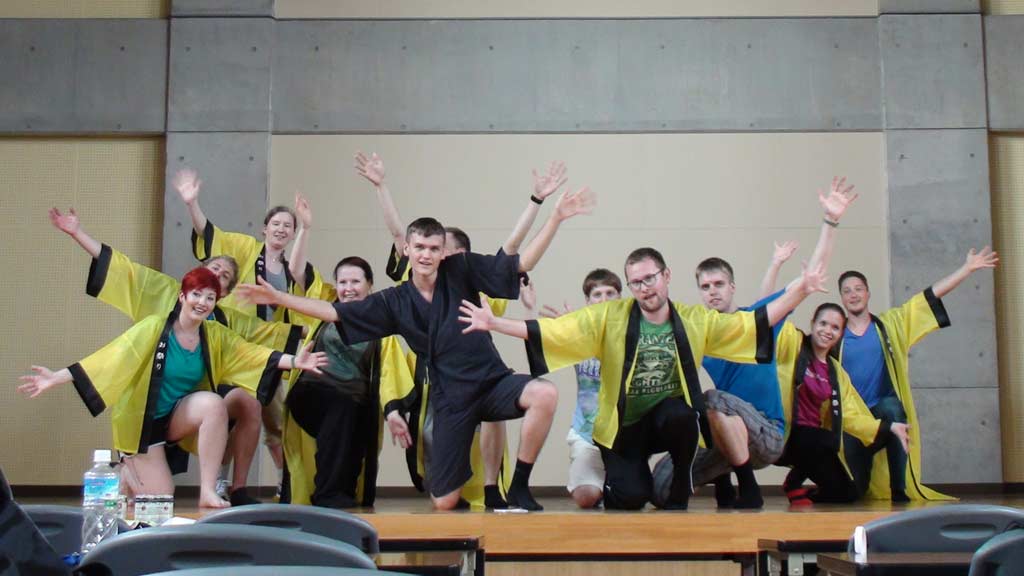
Then came the turn for our Arigato Event, which consisted of several parts. Firstly we thanked the LOC, which was followed by the Japanese Medley – a dance choreography containing several popular Japanese songs and their dance choreographies as performed (or at least attempted) by the World Campus Japan participants. Following the medley we sang the song Tomorrow – from the American musical Annie – arranged so that each country represented in the program got a part in their native language. And thank goodness it went all right. After the song we proceeded to read our thank you letters aloud and present thank you cards to our host families, with whom we stayed to watch a slide show of our stay in Omura (thank you Nicole!).

The Arigato Event proper was followed by a performance from our very own comedian duo Espen and Jurrien, the two funniest men in both Norway and the Netherlands. Their interpretation of the popular Japanese sketch “rassun gorerai” was enough to have the audience wipe tears from their eyes while laughing.

After our short minute in the spotlight was finally over, the brass orchestra took over again and we took over the dance floor with a wide array of samba, conga, trepak and many other dance styles twisted beyond recognition in our amateur hands (or feet?). The point is, we had the fun of our life with our host families, the local people and even the local staff. When the night was finally over we were exhausted, ready to fall asleep on command and as happy as a human being could ever be. What a way to end our stay in Omura City.

Juuso Myller (Finland)

Kyudo

Kyudo

Day of activity: June 15th, 2015

In the afternoon of the 15th of June we got to experience an another traditional Japanese sport – or rather budo. Kyudo literally means the way of the bow, and it is the art of traditional Japanese archery revolving around the buddhist zen-principles. Personally, as I myself do kendo (the way of the sword, or Japanese fencing) back home in Finland, I was really excited to learn about another budo that had its roots in the samurai culture.

After we learned about the principles of kyudo and how it especially follows the principles of zen, we got to see a demonstration of the entire ritual that is shooting with a bow in kyudo fashion. After the demonstration our wishes were fulfilled and we got a chance to try our own archery skills against an army of balloons and bunnies on a cardboard target. Dressed up in traditional hakamas we realized that we were nothing but a mere bunch of fumbling beginners (except for Jurrien) trying to understand what on earth we did wrong when we kept failing again and again. Simply put, shooting a traditional Japanese bow is hard. Eventually, we managed to get the hang of it and everyone hit at least one target and got a medal of (sweet) honor as a trophy.

Along with the excitement of shooting a bow the kyudo experience was a lesson on the principles behind the action. We didn’t only learn to shoot, but also how and why to shoot it like it is taught in kyudo and the teachings and philosophy connected to it. All in all, we learned a lot from our brief visit to the kyudo-jo in Omura City.

Juuso Myller (Finland)

Aileen Shorinji Kempo

Aileen Shorinji Kempo

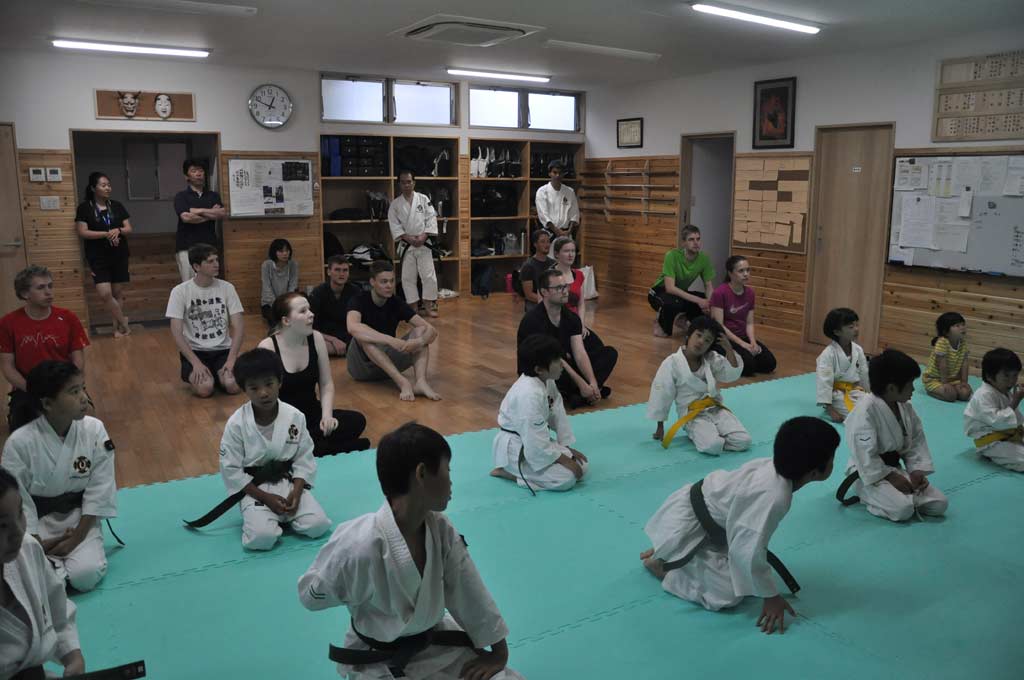
On the 13th of June we went to visit a Shorinji Kenpo Dojo. Since I have some experience with martial arts this was something I had been looking forward to doing and it didn’t disappoint. At first we learned about the history and philosophy behind Shorinji Kenpo. We learned how it had been created in Japan after the Second World War and how it really was a way of life. The teachers clearly had a passion for what they were doing.

When we had lunch we got to interact with some of the young students at the dojo. As always they had tons of energy and lots of smiles for us. After lunch we got our second chance to interact with the kids when the teachers taught us several different techniques and the kids helped us along.

I quickly found out that my experience with other martial arts didn’t help me much, but it was still really fun and quite the experience. It was really amazing to look at the children work and teach. Unlike us, even though they were only second and fourth graders, they clearly knew what they were doing.

After the dojo we had a short visit to a shrine where most of us got our fortunes and luckily mine wasn’t too bad. I ended my day with a BBQ party that my host family held with another host family and some friends. It was really nice and even though I was really tired from all the activities all day I really enjoyed the company and, of course, the food.

Aileen Hay (Norway)

Arigato Event & Country Presentation Day

Arigato Event & Country Presentation Day

Day of activity: August 9th 2014

Yesterday concluded a beautiful chapter of my life. Though I have experienced enough in the last two months to fill in a few years’ worth, I can’t help but feel that this amazing experience came to an end prematurely. As it is for most days in Japan, yesterday’s schedule was quite filled. The Tama community organized an event in which all WCI members got to present their countries to the Japanese youth. After this warm interaction, we moved on to our Thank You event, which consists of dances, musical performances, and other playful activities. It aims to show our gratefulness to all of those involved with the WCI program. This was for me the last of 8 events of this kind, and undoubtedly, it was the most emotional of all; as a mix of joy and nostalgia were present throughout the night. In the last few weeks WCI has become a family to me. We have played together, laughed together, cooked together, and discovered tasty foods together. We have sung together, danced together, and signed a ridiculous amount of thank you cards together. We have been happy together, and we have been sad to say goodbye to each other. Now I hope we take all of this home and make the world a better place together. Love to all my WCI family and everyone who was involved with the program. Thank you Hiro Nishimura for allowing us to live this experience. From the bottom of my silly canadian heart!

Jeremy (Canada)

JUKI company visit

JUKI company visit

Date of activity: August 7th 2014

Today, we were allowed by the JUKI group to tour their facilities. Mainly, they demonstrated how their signature industrial and home model sewing machines worked. It was quite amazing to see all of the ingenuity behind machinery that mostly sits in the back of people’s houses. However, we were given the opportunity to see them in action. Some of us used the machines to sew buttons and others fixed some holes or sewed sturdy stitches. This all paled in comparison to the machine that sewed an entire suit pocket or a suit front all in about a second! This is work, that when done by a human instead of the machine, would require at least half an hour. But this machine did it with care and very fast. It was a surprise to see that the same technology that is used in the big automatic sewing machines was also used to mount chips and other parts onto circuit boards. All in all I learned a lot today and it was a lot of fun!

Michael (USA)